
Solving any triangle
The law of sines and the law of cosines (Carnot's theorem in Italy) let you solve any triangle from three elements, at least one of them a side. With proofs.
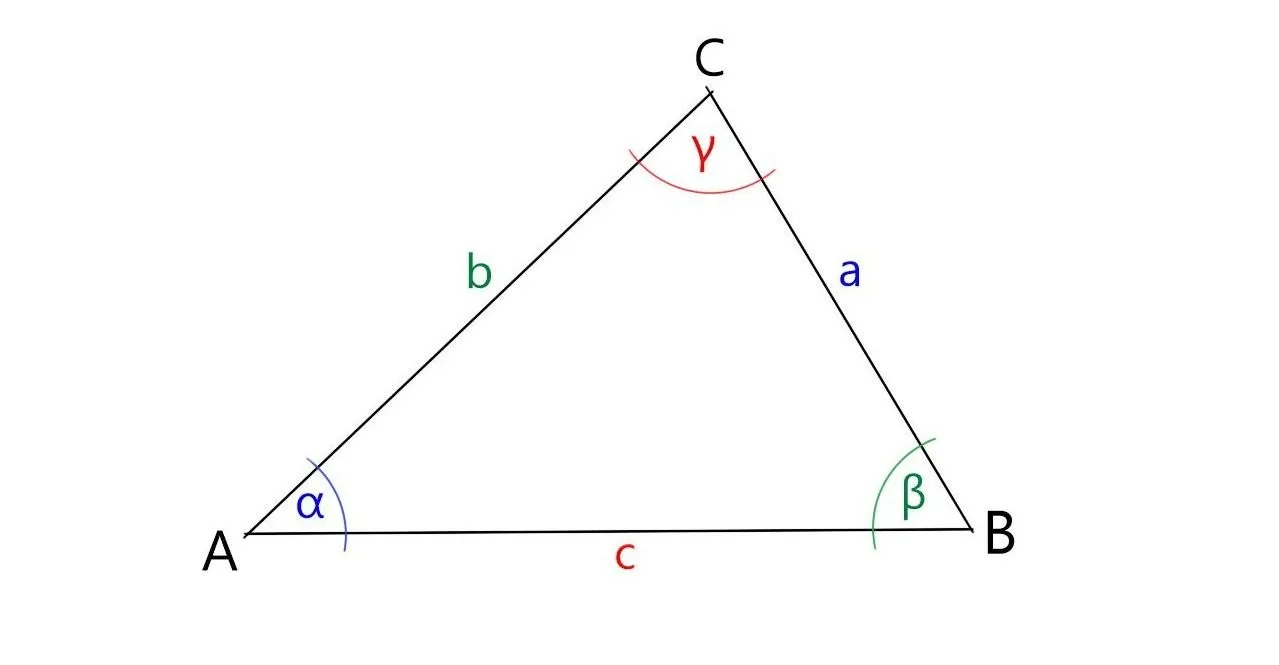
The adjective “any” for a triangle isn’t great.
But it’s the only one I could think of.
Saying “scalene” isn’t enough, because it could be a scalene right-angled triangle, which simplifies things a bit thanks to the ninety-degree angle (I wrote about right-angled triangles here).
So let’s leave the adjective “any” next to the noun triangle.
In this article I’ll talk about the law of sines and the law of cosines (known in Italy as Carnot’s theorem), two very powerful formulas that let you solve any triangle, provided you know at least three elements (angles or sides), at least one of which is a side (three angles aren’t enough, because there are infinitely many similar triangles with the same angles but different sides).
Properties of triangles
Before talking about the two theorems, here is a quick list of the properties of triangles, valid for all of them:
- The interior angles add up to a straight angle (180° or 200 gon);
- Each side is shorter than the sum of the other two and longer than their difference;
- The relations of equal/unequal/greater/smaller between the sides (one side is longer than another, …) also hold for the angles opposite those sides (in the triangle above, c > a and also γ > α).
The theorems for solving a triangle
We draw heavily on trigonometry, and I must say it helps a lot.
If you think about it, being able to solve any triangle knowing half of its elements (sides and angles) is not bad at all!
And from there you can also get the area, because you can find the height by working on the two right-angled triangles that appear as soon as you draw it.
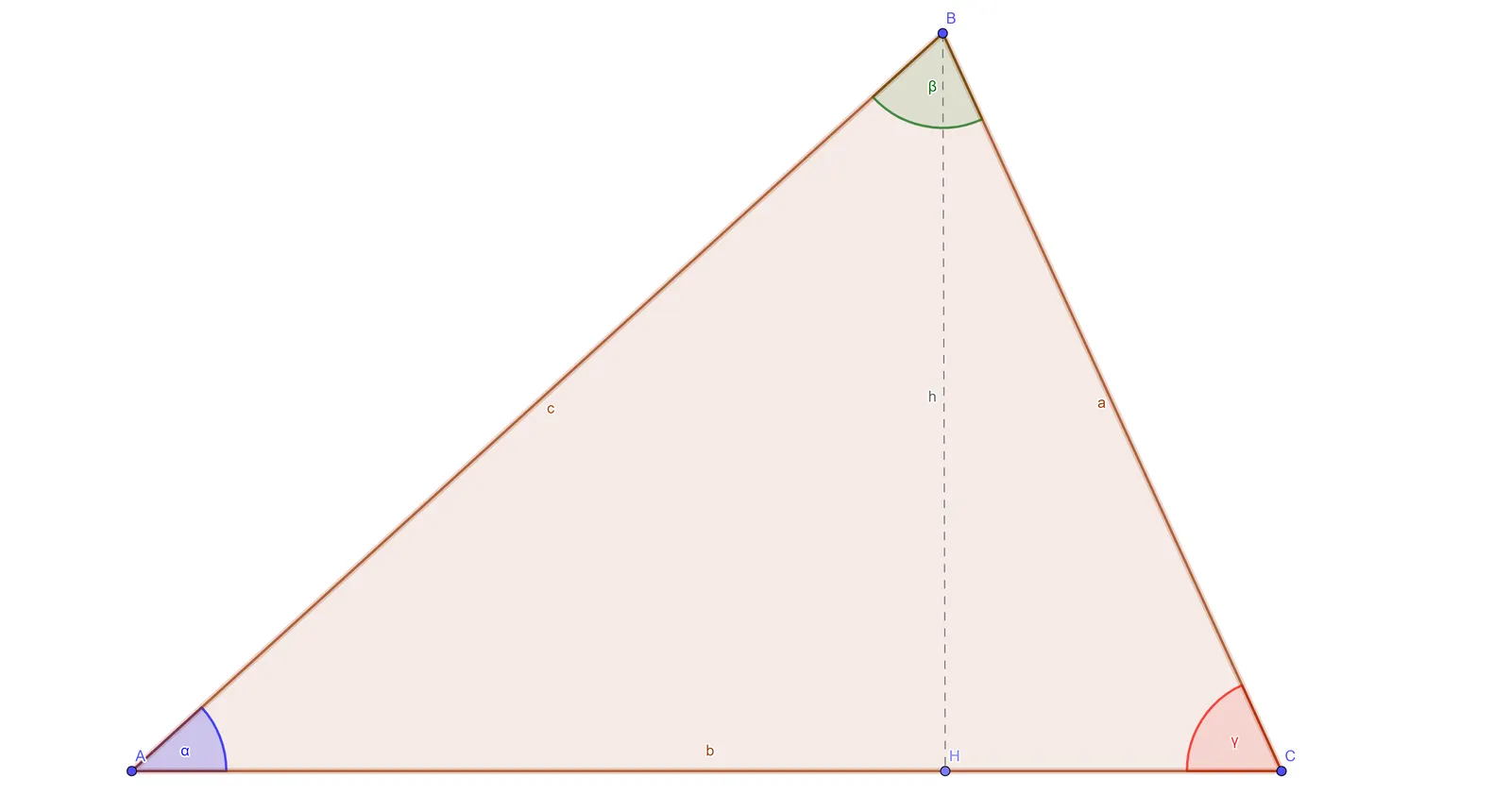
In theory (and in practice) what I told you about right-angled triangles could be enough to solve any triangle.
A height splits it into two right-angled triangles which, solved separately, lead you to the other unknown elements.
But this method isn’t very convenient.
Not because it doesn’t work (quite the opposite!) or is too long, but because there are fundamental theorems that are much more efficient for general triangles.
Originally there were four (in the Italian tradition):
- Law of sines
- Law of cosines (Carnot)
- Napier’s analogies
- Briggs’ formulas
But now only two are remembered (studied and applied), the first two: the law of sines and the law of cosines.
It’s not that Napier and Briggs have been erased from the book of mathematics: their formulas were used many years ago together with logarithm tables (if you’re young you may not even know what they are), and calculators “swept them away”.
And I’ll leave them alone too…
The law of sines
The law of sines says this:
in every triangle the ratio between a side and the sine of the opposite angle is constant (and equal to the diameter of the circumscribed circle).
As a formula you can write it like this:
a/sinα = b/sinβ = c/sinγ = 2R
I don’t find the circumscribed circle part as powerful as the first part, the side/angle ratio, but it comes straight from the proof of the theorem.
Here it is.
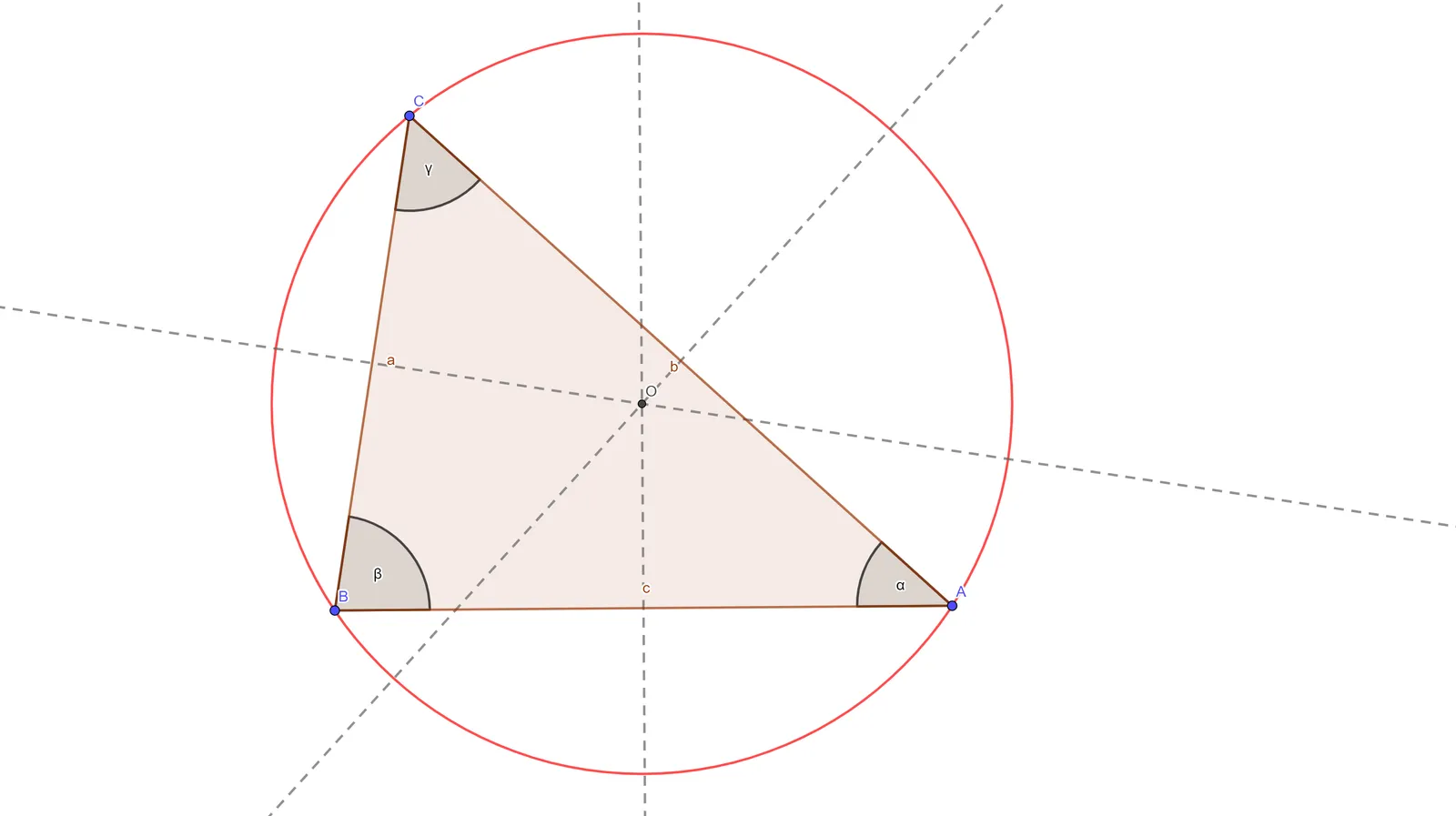
Take any triangle, ABC.
Every triangle can always be inscribed in a circle, and this one is no exception.
So I inscribe it.
The centre of the circle is the “circumcentre”, where the perpendicular bisectors of the sides meet.
Each side of the triangle is a chord of the circle.
And each angle opposite a side is an inscribed angle subtending that side/chord.
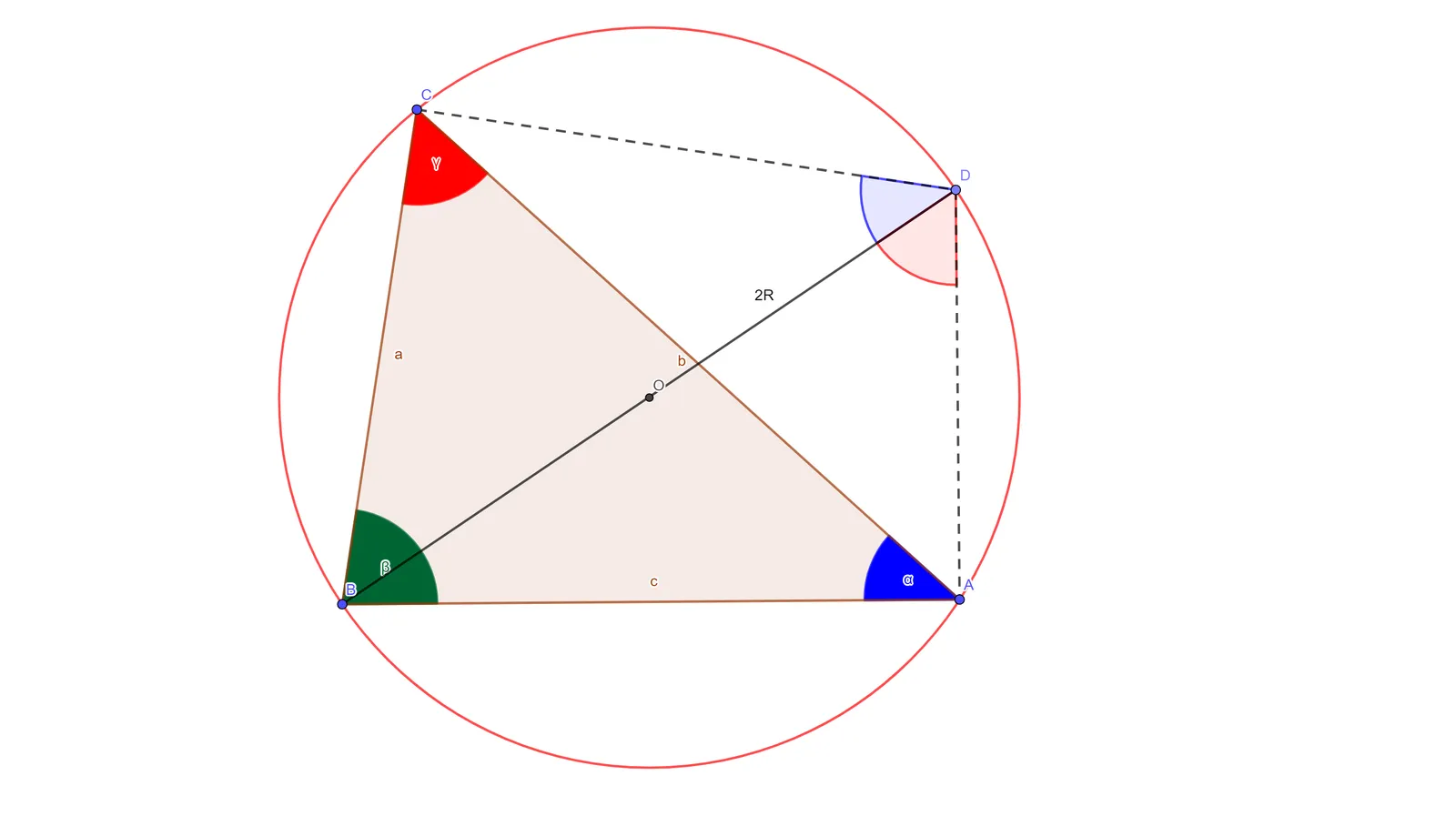
From one vertex I draw the diameter of the circle (2R).
I start it from B and end it at the other point on the circle: D.
If I join D to C and then to A, I get two right-angled triangles, DAB and DCB.
Why are they right-angled?
Because the angles at C and A are inscribed angles subtending a chord that is the diameter BD.
Since an inscribed angle is half the central angle on the same chord, and the central angle BOD is 180°, the two inscribed angles, at A and at C, are right angles.
But I can say more about these triangles.
Angle BDC equals angle α, because they are inscribed angles on the same chord BC, and likewise angle BDA, on chord AB, equals angle γ.
Now I use trigonometry on the “new” right-angled triangles.
They share the hypotenuse, BD = 2R.
From here I can write:
2R = a/sinα
and
2R = c/sinγ
If, on the same principle, I draw the diameter of the circumscribed circle from A instead of B, I can also write:
2R = b/sinβ
And there’s the law of sines:
a/sinα = b/sinβ = c/sinγ = 2R
The “alternative” law of sines
Maybe the heading is an exaggeration.
It’s just to tell you that you can write the law of sines like this:
a/b = sinα/sinβ
b/c = sinβ/sinγ
a/c = sinα/sinγ
which, in words, means that in every triangle the ratio between two sides equals the ratio between the sines of the opposite angles.
The law of cosines (Carnot’s theorem)
If you remember some physics and Carnot’s theorem in thermodynamics, you may be pleased to know that the Carnot of the Italian name for the law of cosines was the father of that one.
Sadi Carnot was the physicist, while Lazare Carnot was the mathematician I’m referring to in this article.
Maybe you don’t care at all…
But I like writing it, because I myself thought they were the same person!
🙂
The experts say that the law of cosines is the extension of Pythagoras’ theorem to any triangle.
And they’re right!
I’ll give you the formula straight away, so the similarity is clearer.
Or rather, the formulas…
a² = b² + c² – 2bc cosα
b² = a² + c² – 2ac cosβ
c² = a² + b² – 2ab cosγ
And here is the statement:
In every triangle, the square of one side equals the sum of the squares of the other two (so far we’re close to Pythagoras) minus twice their product times the cosine of the angle between them (meaning the other two sides…)
This too can be proved in a few lines.
Look at triangle ABC above.
I draw the height BH, which splits it into two right-angled triangles, AHB and BHC.
I take the one on the right, BHC, and applying Pythagoras’ theorem I can write:
a² = CH² + BH²
Moving to the triangle on the left, AHB, I can write:
BH = c sinα
AH = c cosα
Back to the first triangle, I can also write
CH = AC – AH
CH = b – c cosα
If I now take what I found for CH and BH and put it into the formula for a², I get:
a² = (b – c cosα)² + (c sinα)²
I do some algebra and expand the square of the first binomial
a² = b² + c²cos²α – 2bc cosα + c²sin²α
a² = b² + c² (cos²α + sin²α) – 2bc cosα
If you remember the fundamental trigonometric identity, you can write (cos²α + sin²α) = 1
And so:
a² = b² + c² – 2bc cosα
If you repeat the procedure with the other two heights, you easily get the other two formulas.
It’s called the law of cosines because the trigonometric function that ends up in the relations is the cosine.
But I think that was fairly obvious…
🙂
Why the law of cosines?
Try solving with the law of sines a triangle whose three sides you know…
You won’t manage.
If you don’t want to go through the right-angled triangles that pop up with the heights, you need the law of cosines.
You find an angle between two sides, and from there the triangle unlocks and you can find the other two angles.
Now you have a small arsenal of information to solve any triangle.
And from triangles you easily move on to polygons with more sides, because you can always divide their area into two or more triangles.
It will take a while to solve them one after another, but the triangle lets you get out of a geometric problem.
And from a geometric problem to a surveying one is a short step!