
Solving a right-angled triangle
How to solve any right-angled triangle with sine, cosine and tangent: properties, formulas, the rules in words and the four possible cases.
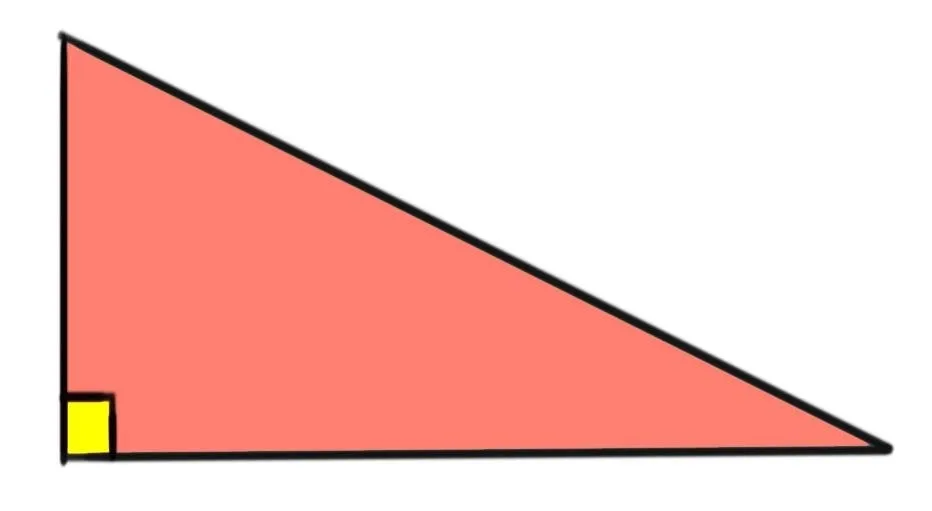
After the short trip through trigonometry in the previous articles (a rather quick exploration, in fact…) I can finally show you one of the things sine, cosine and tangent are for: solving a right-angled triangle.
I’ll do it here with any right-angled triangle, using the trigonometric functions.
There is one “but”.
For everything to work, you must know at least two elements of the triangle, and one of them must be a side.
The right-angled triangle
If the triangle is a “noble” geometric figure in surveying (because it is extremely useful), the right-angled one has some extra perks.
Here they are in short.
- You always know one angle, the right angle, which is 90° (or 100 gon, or π/2);
- You know the sum of the other two, and it is, again, 90°.
Because the interior angles of a triangle add up to 180° (200 gon), and since you already know one is 90°, the other two together can only make 180°-90°=90°.
The interior angles of a right-angled triangle, other than the right angle, are complementary. - Because of what I’ve just written, there can be no obtuse right-angled triangles.
- Nor is there an equilateral right-angled triangle.
The interior angles of an equilateral triangle are, of course, all equal, at 60°.
In a right-angled triangle one angle is already 90°, which blows the whole equilateral plan sky-high. - The sum of the two shorter sides (the legs) is greater than the hypotenuse.
- The sum of the squares of the legs equals the square of the hypotenuse.
If you didn’t read that carefully, go back to the line above.
It is the famous Pythagorean theorem, one of the most powerful and useful things you meet on the journey through geometry.
Not bad, all this stuff!
🙂
Right-angled triangle and unit circle
If you look at the unit circle I used to talk about sine and cosine, you notice straight away that there is a right-angled triangle in the middle.
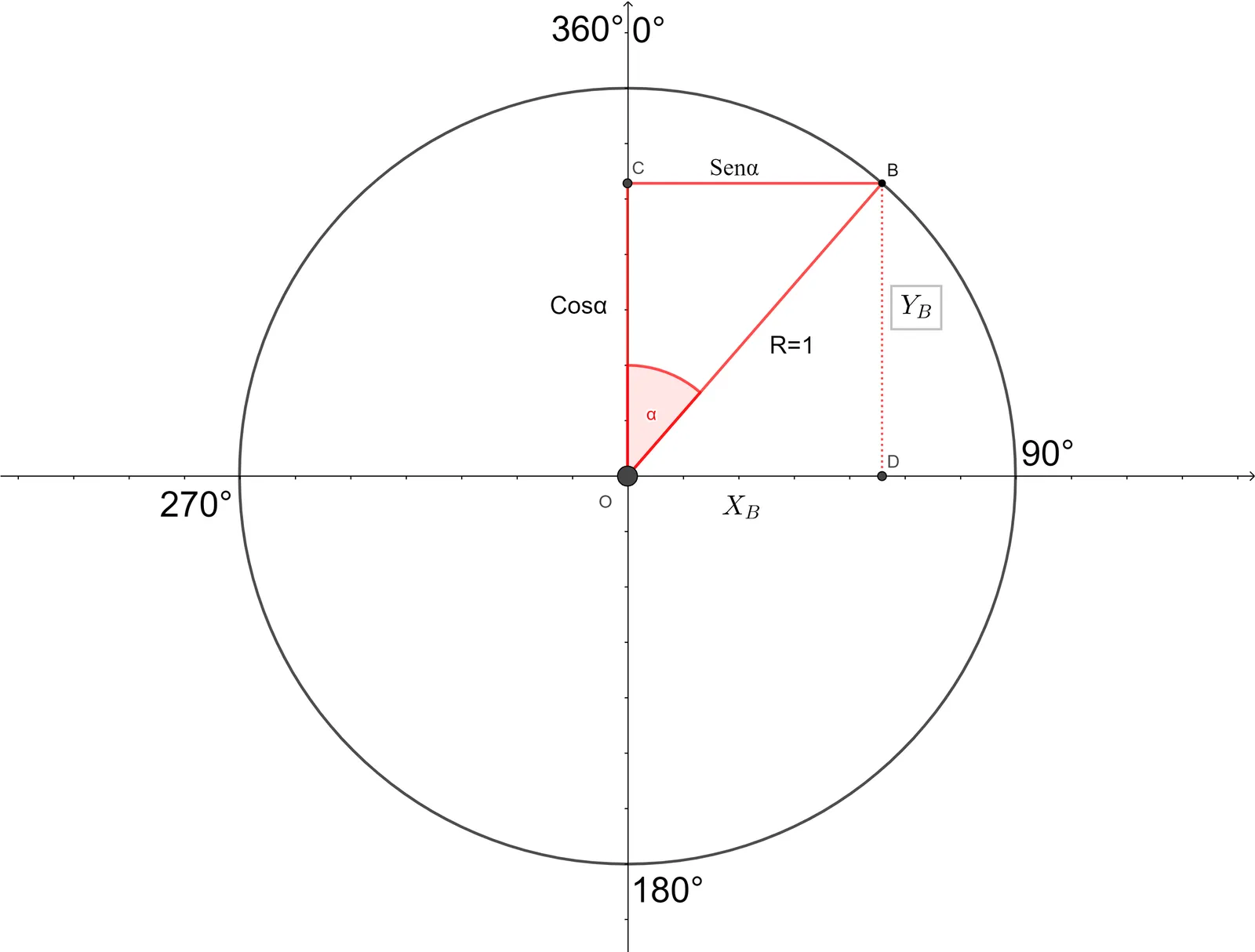
This one is called BCO, and the right angle is at C.
Interestingly, the hypotenuse of this triangle, OB, is the radius of the circle (which is 1 in this particular case), while the two legs are the sine and cosine of the oriented angle α.
Solving with sine and cosine
Go back to the definitions of sine and cosine.
sinα = BC/OB
cosα = OC/OB
And from here you can write
BC = OB sinα
OC = OB cosα
What I’ve written above doesn’t only hold in the unit circle.
It always holds.
For every right-angled triangle.
Solving with the tangent
In the same way you can take the definition of the tangent and use it to find the sides of the triangle.
tanα = sinα / cosα
Since you know the sine and cosine of α (if you have a sudden blank, you can read them a few lines above), you can write:
tanα = BC / OC
From which
BC = OC tanα
OC = BC (1/tanα)
and since 1/tanα = cotα
OC = BC cotα
And this too holds for all right-angled triangles.
The rules “in words”
Well, that’s it…
“It” is a manner of speaking.
They are really powerful tools, and their strength, like that of Pythagoras’ theorem (and other things I’ll tell you about in the next parts), lies in the fact that they hold for all right-angled triangles.
Pretty, ugly, tall, short, thin, fat…
They work for all of them.
No exceptions.
As long as one of the three angles is a right angle.
When I studied them at school, (alas) many years ago, I memorised the statements, without going through symbols, numbers and other inventions.
And they stuck in my head.
Even years later.
The statements are just the formulas I’ve written, translated into words.
Here they are.
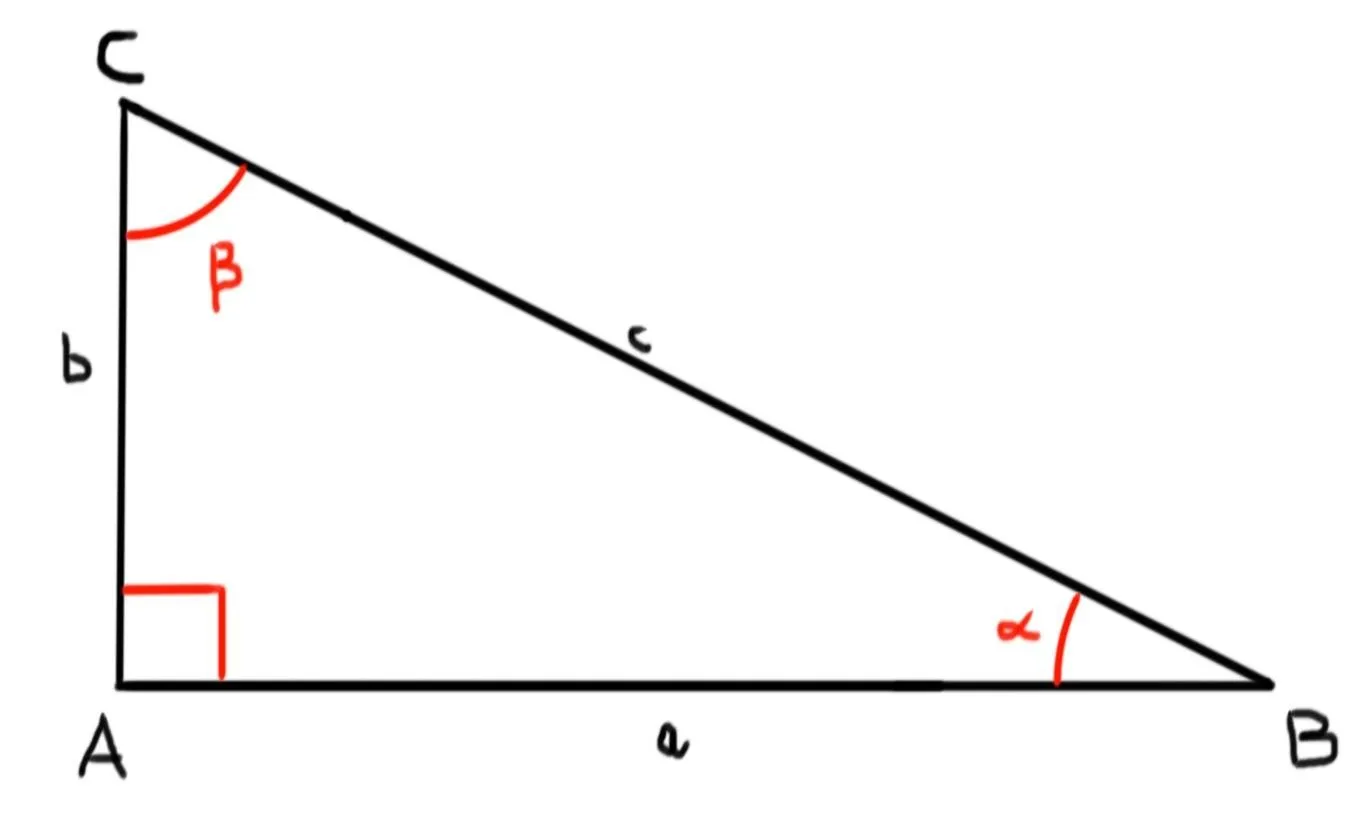
The premise valid for all of them is: in every right-angled triangle…
- a leg equals the hypotenuse times the sine of the opposite angle (opposite the leg), or the hypotenuse times the cosine of the adjacent angle (between the leg and the hypotenuse);
- a leg equals the other leg times the tangent of the opposite angle (again, opposite the leg), or the other leg times the cotangent of the adjacent angle (between the leg and the hypotenuse).
You can turn the first statement around and look at things from the hypotenuse’s point of view:
- the hypotenuse equals a leg divided by the sine of the opposite angle (opposite that leg), or a leg divided by the cosine of the angle between that leg and the hypotenuse.
In practice…
There are four cases you can meet when dealing with right-angled triangles.
- You know the two legs;
- You know a leg and the hypotenuse;
- You know a leg and an angle;
- You know the hypotenuse and an angle.
Obviously, in points 3 and 4, the angle I mean is not the right angle.
Solving a triangle means getting to know all its main elements: 3 angles and 3 sides.
But now that you know how, there’s nothing to scare you!
🙂
It’s a matter of three steps in a row, applying the formulas I’ve given you and finding the missing elements one at a time.