Sine and cosine
Sine and cosine explained simply with the unit circle used in surveying: definitions, key values, the fundamental identity, graphs and related angles.
Sine and cosine are trigonometric functions.
…
The aim of these articles is to (try to) talk about mathematical/geometric/surveying things, sometimes complex ones, in a simple way.
And this opening doesn’t work…
I need to take a step back and start from a bit further away.
Plane trigonometry
Everything you learnt at (middle) school about plane figures, perimeters, solids, areas, volumes, Pythagoras’ theorem, …, is terribly important but doesn’t help you in practice.
For polygons, the theorems and relations of elementary geometry link ONLY their sides OR their angles.
And that is a bit limiting.
Because if you try to find the angles of a triangle knowing its sides, you can’t.
Trust me, that’s how it is…
OK, the equilateral triangle doesn’t count!
🙂
You need something more.
And here plane trigonometry comes to the rescue.
The mission of plane trigonometry is to find out how the sides and angles of triangles relate to each other.
You could say trigonometry is open-minded.
Angles with angles, sides with sides and sides with angles are all fine with it…
And even if it may seem a bit elitist, dealing only with triangles, you can apply it to any (plane) figure.
The area of any polygon can always be split into triangles by drawing diagonals here and there.
And the triangle is one of the most powerful geometric figures there is.
I don’t know if that’s true for everyone, but for surveyors it certainly is!
To level up and really use plane trigonometry, you need to meet some new characters, some new functions: the trigonometric functions.
Sine, cosine, tangent, arcsine, arccosine, cotangent, arctangent, cosecant, …
They are all trigonometric functions.
And they are linked by a fundamental geometric entity, the (oriented) angle.
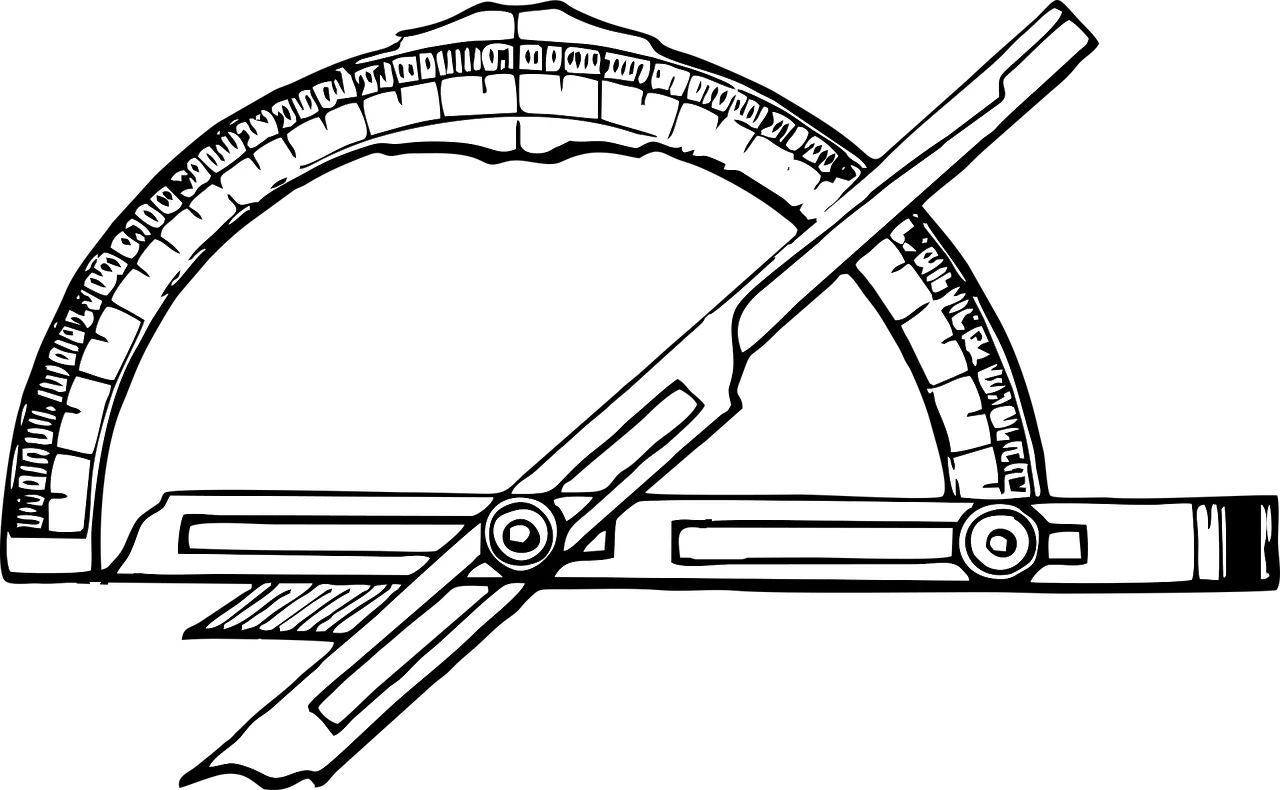
In Italian they are called funzioni goniometriche, because they are tied to the measurement of angles, and the goniometro (protractor) is the instrument that measures them (from the Greek gonio + metron).
Some (not many, to be honest) also call them circular functions, because they are built on a special circle (the unit circle I’m about to introduce), or trigonometric functions, because they are used in trigonometry.
Here I’ll talk about sine and cosine.
The unit circle
I’ll tell you right away that the unit circle isn’t essential for getting to the trigonometric functions.
But it helps you understand what they are.
Especially sine and cosine.
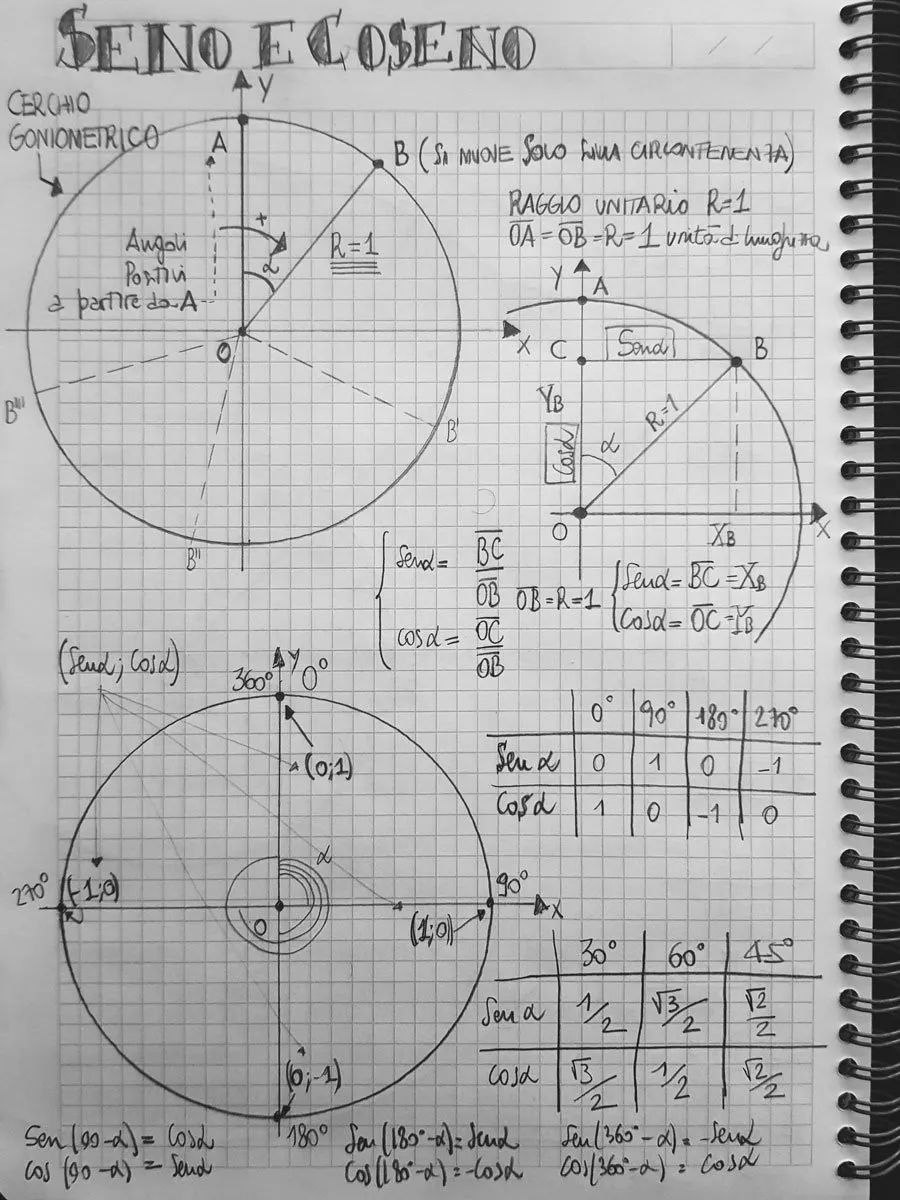
A unit circle (or trigonometric circle) is a circle.
So far so good.
Its centre “O” is the origin of a pair of perpendicular Cartesian axes: X and Y.
The point where the Y axis meets the circle is point “A”, and angles are measured from here.
Side OA (angles have two sides) is the initial side, the one that moves around O.
The unit circle has a radius of one, R=1
Yes, but “1” what?
“1” unit of length.
Not metres, not centimetres.
The radius acts as the unit of measurement of the whole Cartesian system (even if saying “this length measures 13 radii” isn’t great…)
Note: this is the surveying version of the unit circle, with angles measured clockwise from the Y axis (north). In mathematics they are usually measured anticlockwise from the X axis, which swaps the roles of X and Y below.
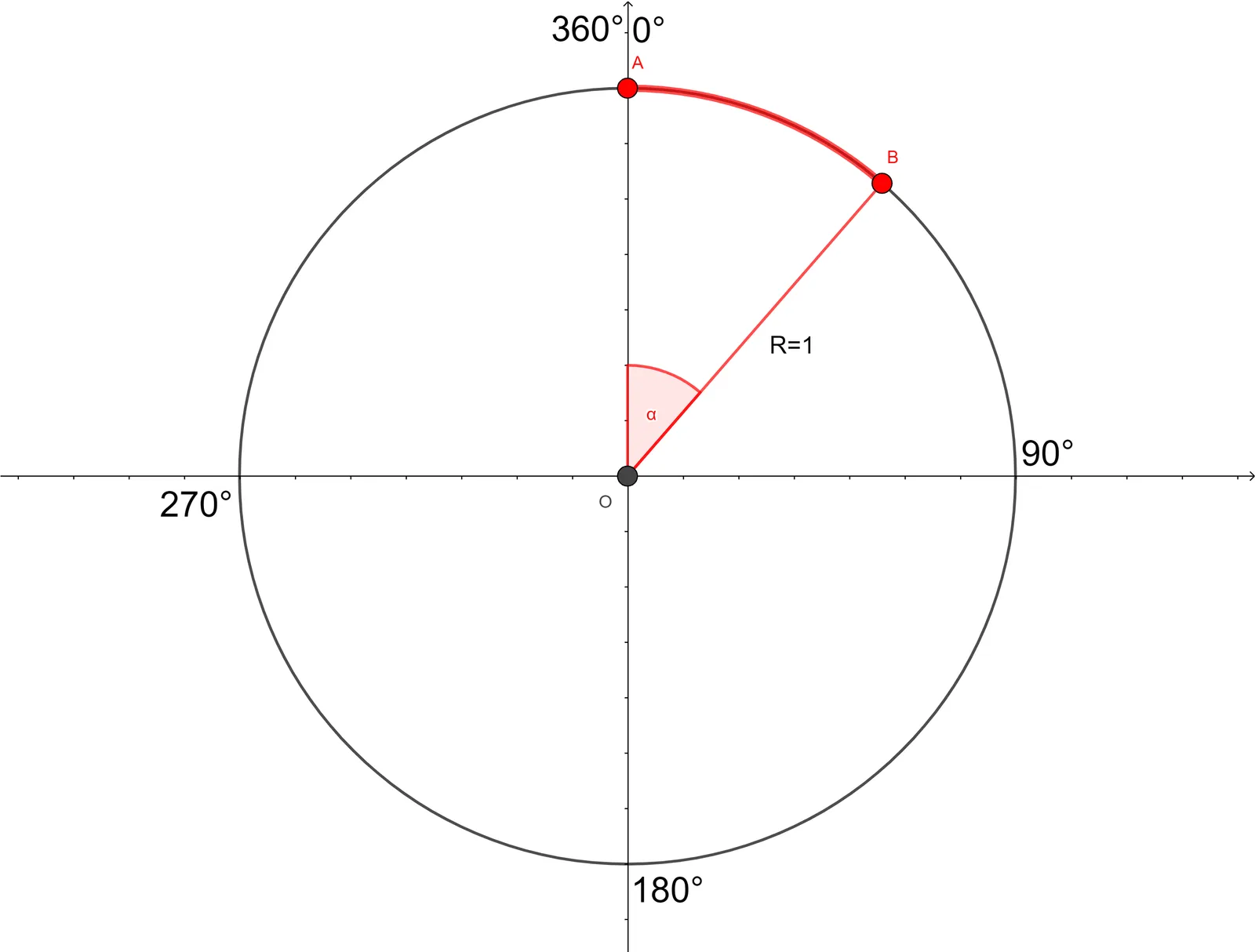
Above is a unit circle, and now I’ll show you how you can see, straight away and graphically, which is the sine and which is the cosine.
Take point B.
B is a random point on the circle.
But it can only lie on the circle, without entering the area inside or wandering off into the infinite plane outside.
OB is the segment joining it to the centre.
And it is as long as the radius.
Since we are in a unit circle, with a radius of one, OB=1.
Whatever position B takes, it depends only on the angle α.
It’s as if there were a stake driven into the ground at O, with a rope tied to it, and point B at the other end, moving while keeping the rope (OB) taut.
The position of B really depends only on α.
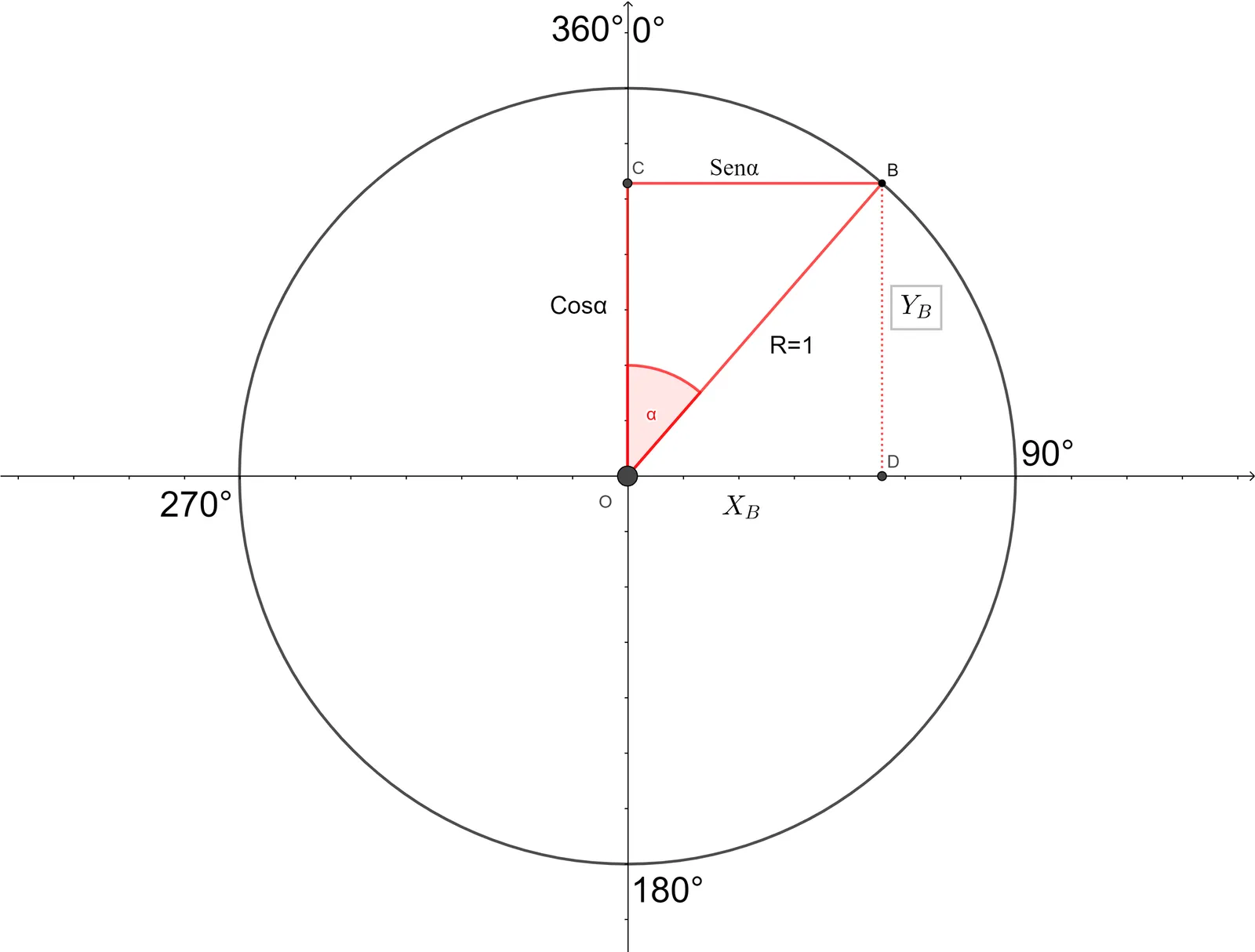
And since the unit circle automatically creates a Cartesian plane centred on O, the position of B can be split into its two coordinates, XB and YB.
They too depend only on the angle α.
Fairly obvious, I think…
Sine and cosine
Now I’m ready to tell you what sine and cosine are, mathematically (and geometrically).
The first thing to know is that sine and cosine, like all trigonometric functions, are always tied to angles.
There is a sine of an angle, but you’ll never find the cosine of a speed…
Now look at the image above and the right-angled triangle OBC.
The sine of the angle α is the ratio between side BC and the hypotenuse OB.
The cosine of α is the ratio between the other side OC and, again, the hypotenuse OB.
So:
sinα = BC/OB
cosα = OC/OB
Since OB is the hypotenuse of the right-angled triangle but also the radius of the circle, R, you can write:
sinα = BC/R
cosα = OC/R
But what is the unit of sine and cosine?
There isn’t one.
They are pure numbers, dimensionless, because they come from the ratio of two lengths.
Since you are in a unit circle, where the radius is the reference unit for the whole thing, R=1, you make no mistake writing:
sinα = BC
cosα = OC
Looking at point B in the Cartesian plane, BC is its abscissa and OC its ordinate. They are, respectively, the X and Y coordinates.
So:
sinα = XB
cosα = YB
But careful: these last two relations hold ONLY in the home of the unit circle.
In reality sine and cosine are always ratios of segments (that’s why I gave you their definition first), and as such they exist outside the unit circle too.
Sine and cosine of “important” angles
It’s not that some angles are more important than others…
It’s that for some it is easier to remember the values of sine and cosine.
Either because they are 0, 1 or -1, or because they are numbers (pure decimals or mixed – integer and square root) easier to file away in your head than 0.876475932….
I’ll start with the first group…
Work on the unit circle.
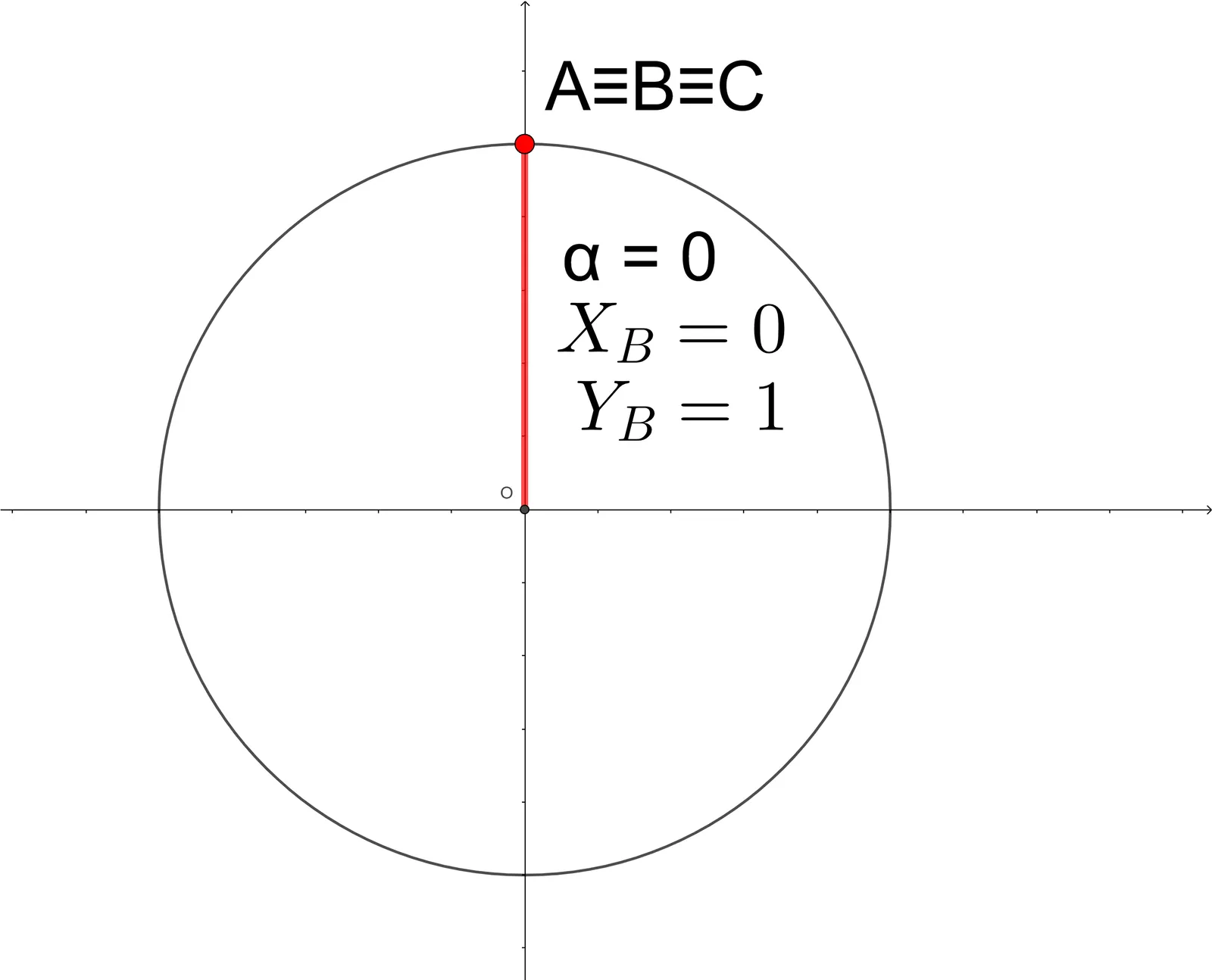
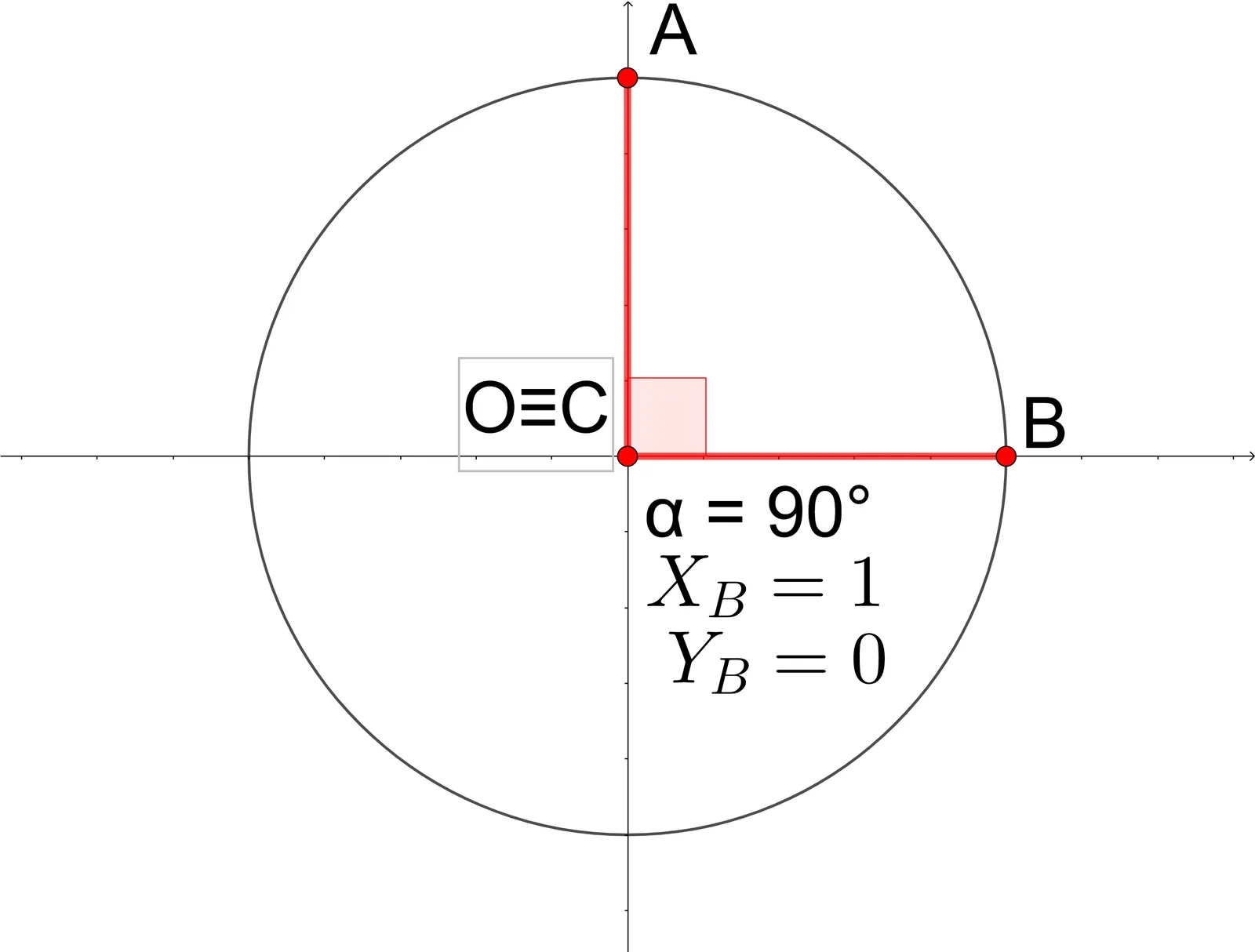
Point A is where the Y axis meets the circle.
Point O is the centre.
Point B moves ONLY on the circle, clockwise from A.
Point C is the projection of B onto the Y axis.
I’ll say it once more: it all depends on the angle α.
And here is what happens as α increases by 90°, starting from 0° and reaching the angles that define the 4 quadrants:
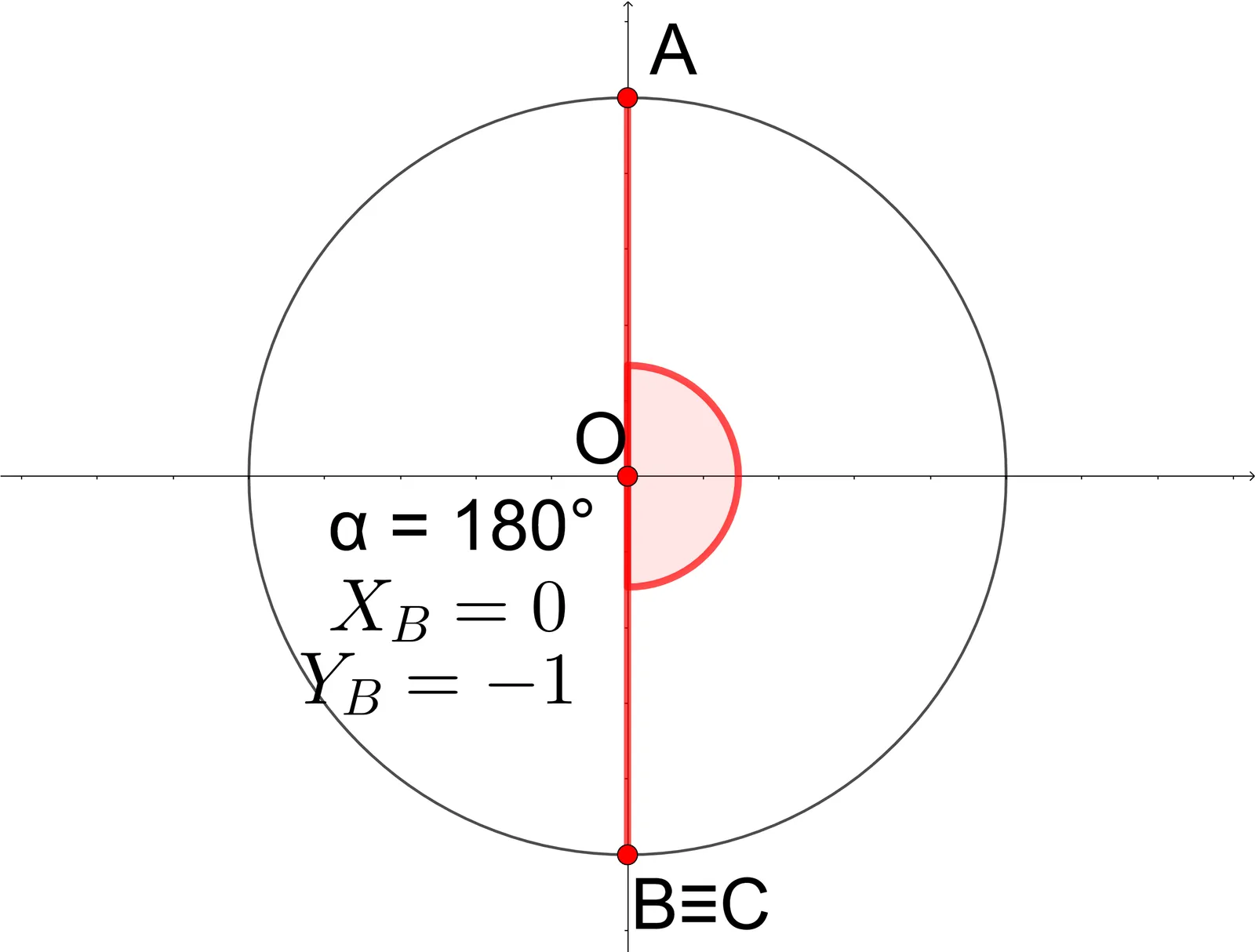
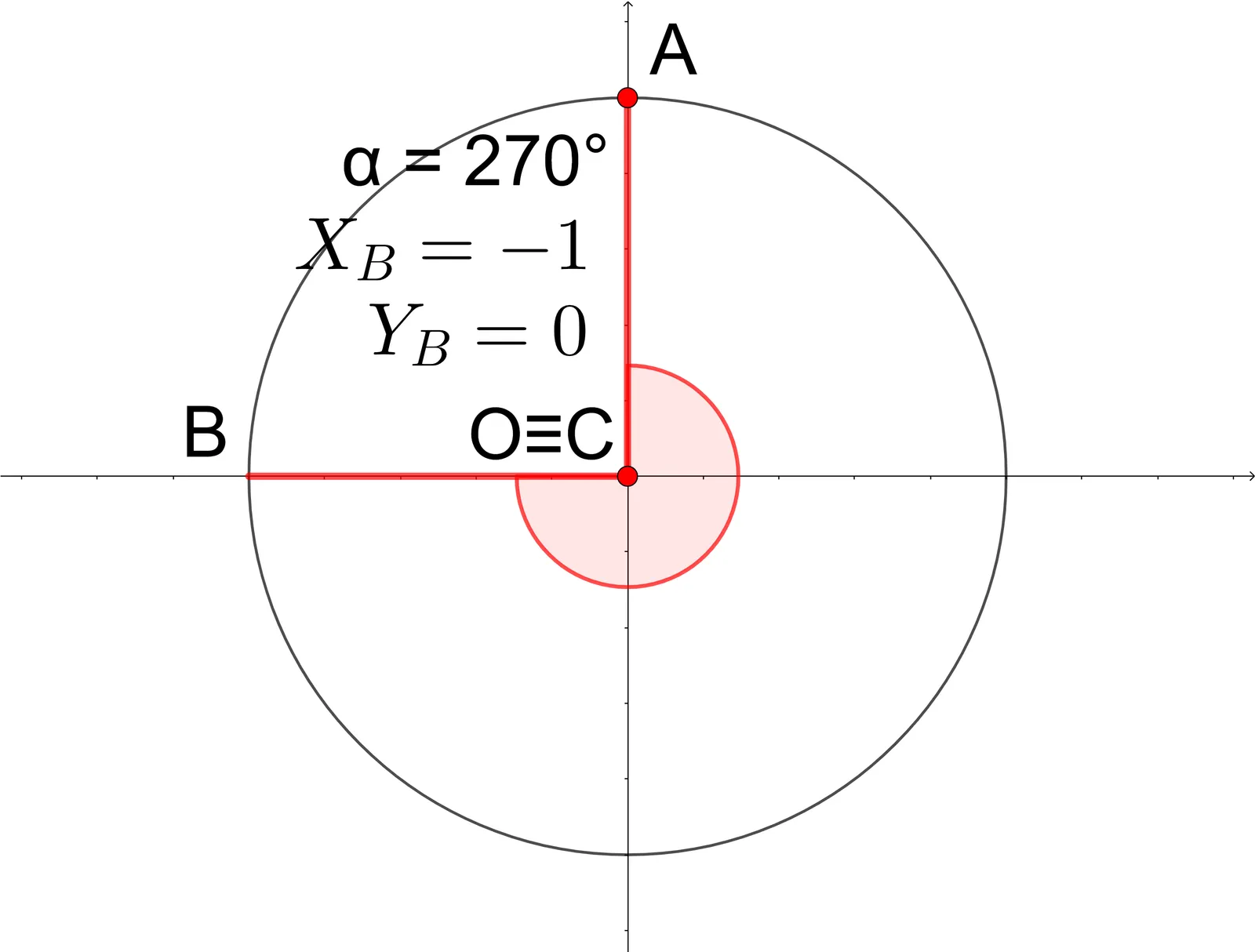
Since:
sinα = XB
cosα = YB
here is a set of easy, easy-to-remember values for sine and cosine.
sin0° = 0
cos0° = 1
sin90° = 1
cos90° = 0
sin180° = 0
cos180° = -1
sin270° = -1
cos270° = 0
The fundamental trigonometric identity
If you look at sine and cosine in the unit circle you immediately notice they are the two sides of a right-angled triangle whose hypotenuse is the radius R.
So you can use Pythagoras’ theorem to write:
sin²α + cos²α = R²
But since the radius is 1:
sin²α + cos²α = 1
This is an important formula, called the fundamental trigonometric identity (or Pythagorean identity).
The sum of the squares of the sine and cosine of the same angle is always 1.
Sine and cosine, periodic functions
Sine and cosine are periodic functions.
They repeat.
Every 360°.
After a full angle, sine and cosine take the same values again.
Other “handy” angles
There are other handy angles whose sine and cosine are easy to remember.
They are 30°, 45° and 60°.
You can prove the values of sine and cosine of these angles geometrically, in all three cases.
I won’t.
I’d love to (I’m a bit of a proof nerd), and they are very simple reasoning on right-angled triangles, equilateral triangles and squares, but it would take me ages with this text editor.
So I’ll ask you to trust me when I write:
sin30° = 1/2
cos30° = √3/2
sin60° = √3/2
cos60° = 1/2
sin45° = √2/2
cos45° = √2/2
There is only one angle (between 0° and 90°) for which sine and cosine are equal, and it is 45°.
For all the others they are different.
Limits of sine and cosine
It’s also easy to set the limits, maximum and minimum, of these two functions.
Looking at the unit circle and checking the values of sine and cosine for the angles dividing the quadrants (0°, 90°, 180°, 270°), you can see the maximum is 1 and the minimum -1.
For all other angles you can take a scientific calculator and try random numbers (although you can see it directly on the unit circle).
You’ll always find that no result is greater than 1 or less than -1.
So:
-1 ≤ sinα ≤ 1
-1 ≤ cosα ≤ 1
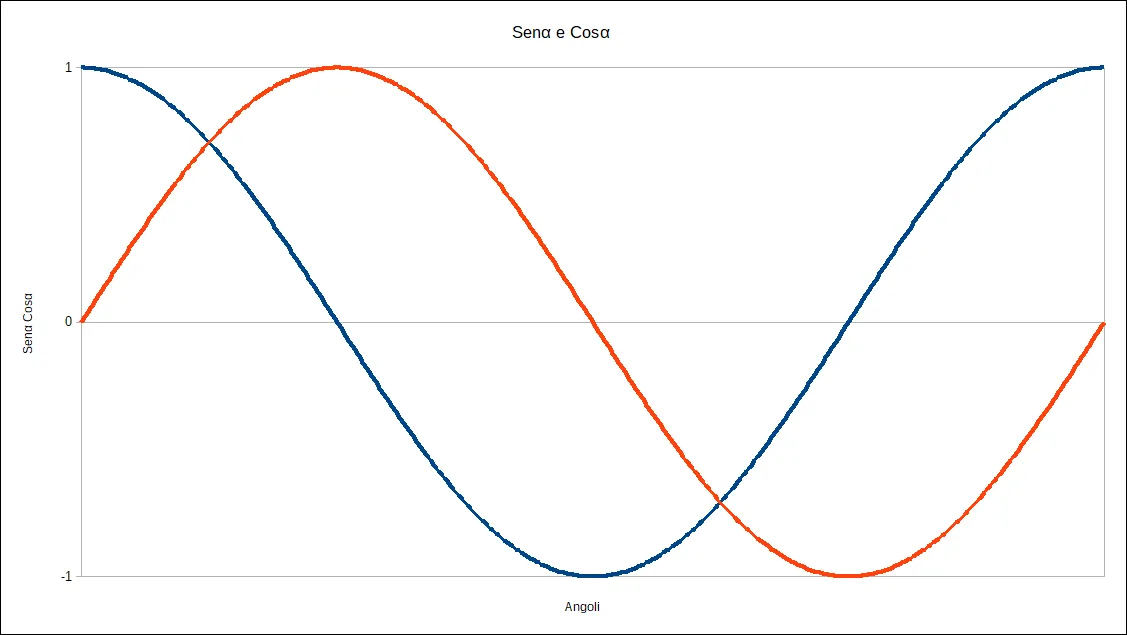
Graphs of sine and cosine
Ever heard of a “sinusoid” (sine wave)?
Here it is!
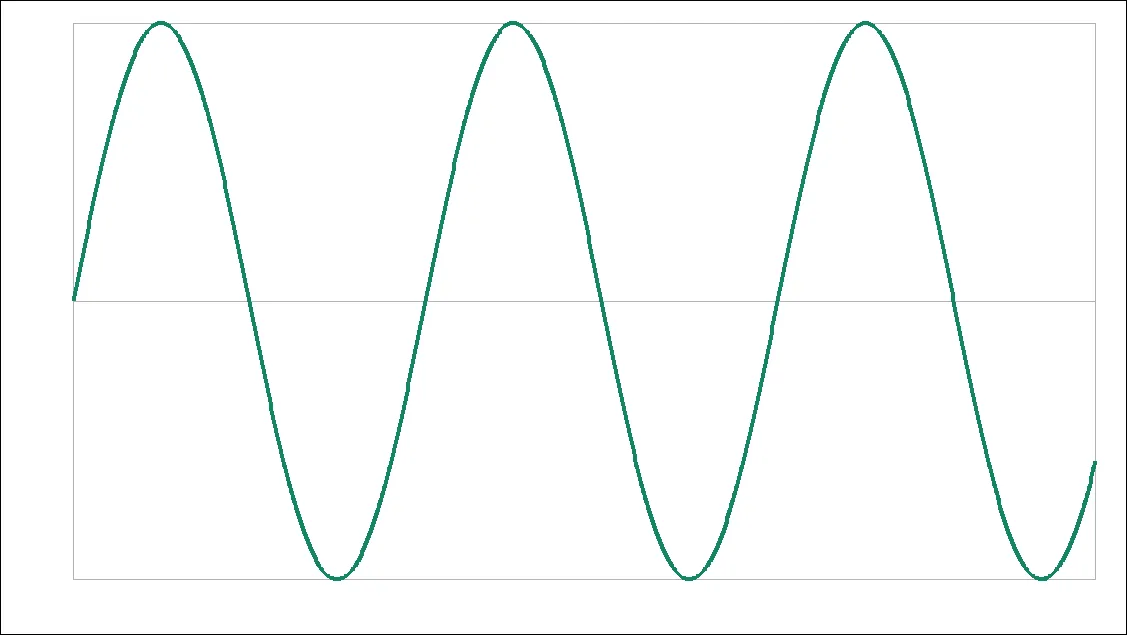
It looks like waves rolling towards the shore, or radio frequencies propagating through space.
And it repeats…
It’s called a sinusoid because it comes from the graph of the “sine” function.
It isn’t hard to create (nor is the cosine one).
All you need is a spreadsheet with a column of angles (from 0° to 360°) and one with the formula for the sine.
The result is this:
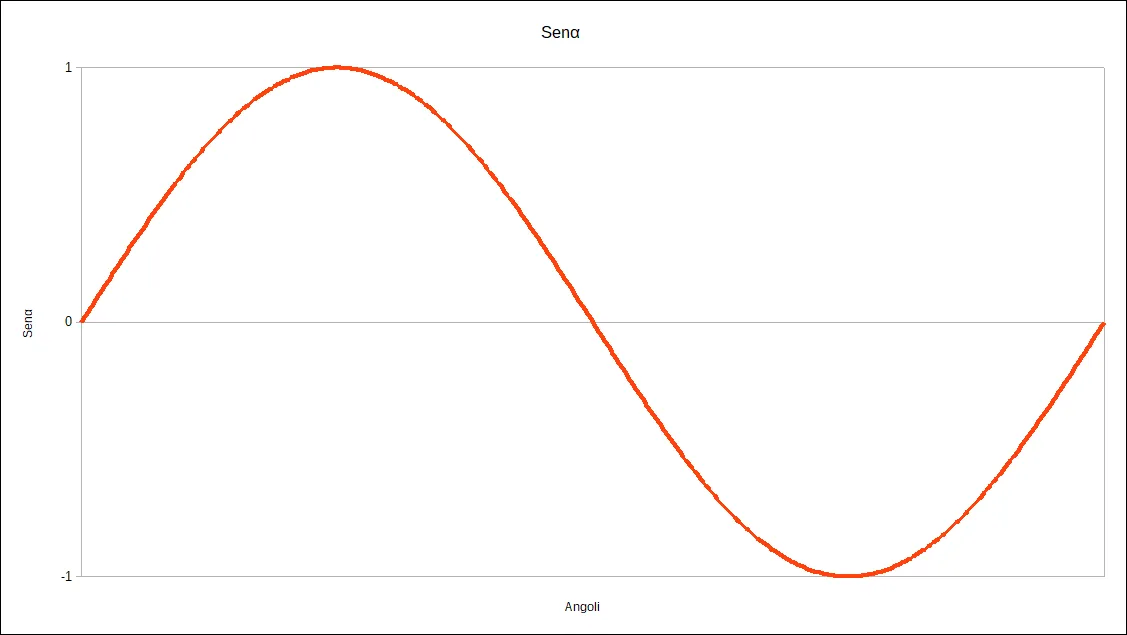
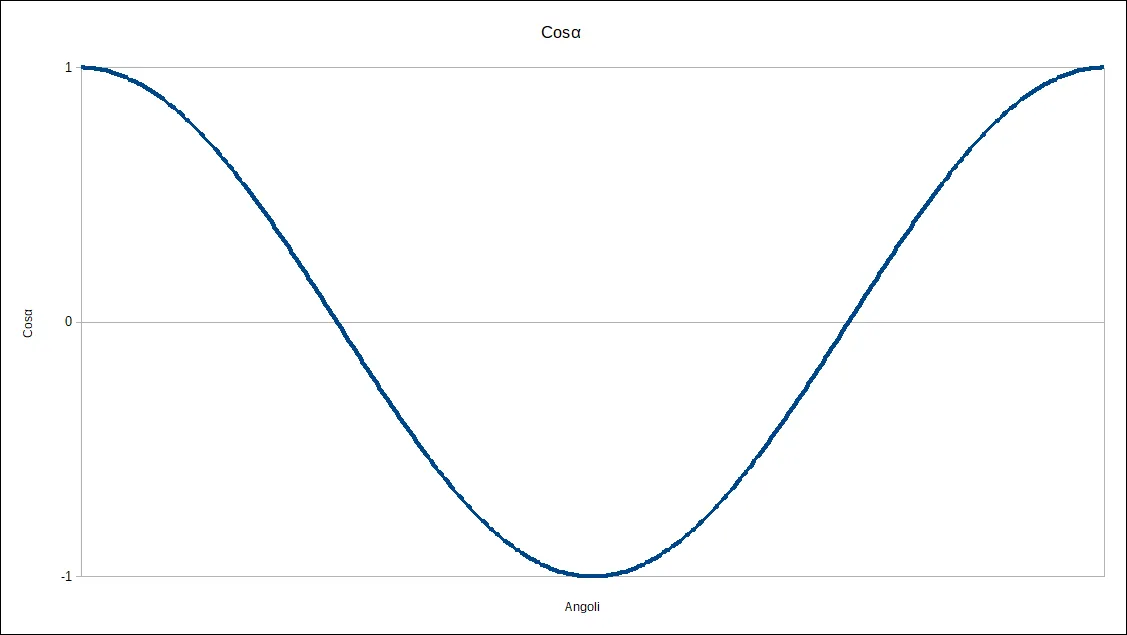
If you do it for the cosine you get the curve below.
It has the same shape (same amplitude and same slope), but instead of starting from 0, it starts from 1 (because the cosine of 0° is 1).
Here they are together!
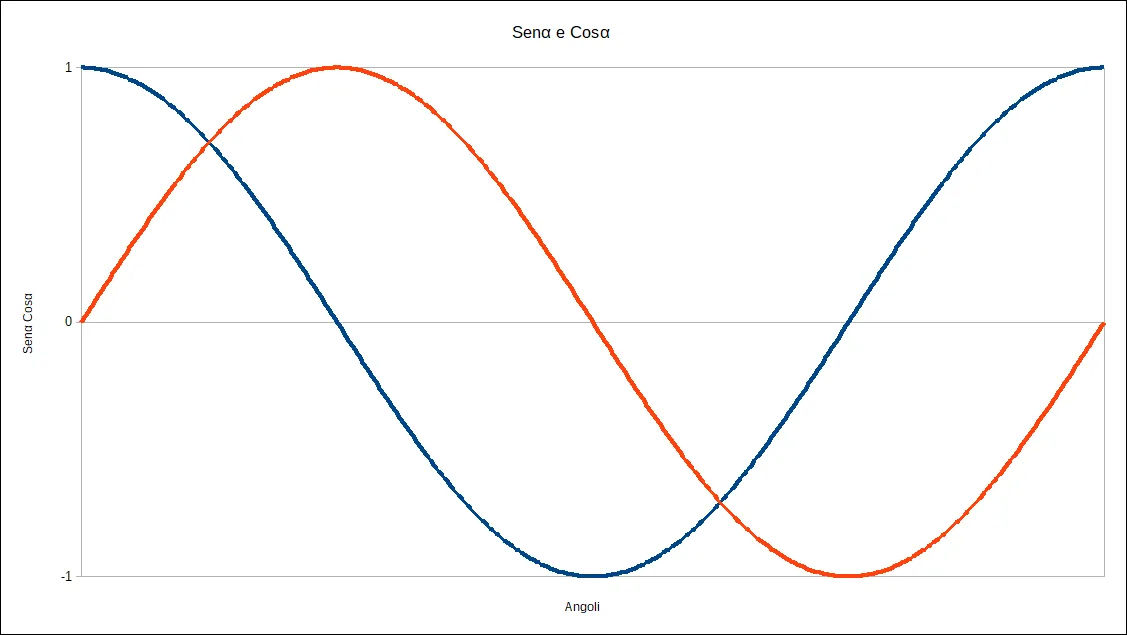
If instead of stopping at 360° on the x axis (as I did here) you carry on, the curve repeats identically forever, creating the sine wave.
Confirming, once again, that these trigonometric functions are periodic.
Complementary, supplementary and explementary angles
I’ll finish by giving you some relations linking the sine and cosine of complementary, supplementary and explementary angles.
Just to leave nothing behind or to chance:
Two angles are complementary if they add up to a right angle (90°);
two angles are supplementary if they add up to a straight angle (180°);
two angles are explementary if they add up to a full angle (360°).
All of the following can be proved too.
It isn’t hard.
You just work, again, on the unit circle.
But I won’t…
So I’ll just tell you that:
sin (90° – α) = cosα
cos (90° – α) = sinα
sin (180° – α) = sinα
cos (180° – α) = – cosα
sin (360° – α) = – sinα
cos (360° – α) = cosα
Why sine and cosine
If you are a professional who works with measurement, I’ll have written trivial things.
If you are a researcher, a lecturer or an academic, you won’t have made it to these final lines.
If you are a student, I hope these lines are useful to you or at least less dry than some definitions and boxes in textbooks.
In any case, sine and cosine are essential for solving triangles, which are the basic geometric figures in surveying practice.
Every problem can be simplified into triangles.
And if you can solve them, you can untangle the knot.
It’s true that spreadsheets and the software on measuring instruments do everything for you without much effort on your part.
But I believe knowing what’s behind the result is a weapon you carry in your pocket and can draw whenever things go wrong…