Units of angle measurement
Radians, sexagesimal degrees, decimal degrees and gons: what they are, why surveyors use them and how to convert from one to another.
If you look for the unit of measurement of angles among the 7 base units of the International System (SI), you won’t find it.
You’ll find it among the derived ones.
But it was squeezed in “by force”.
Yes, because the angle is a dimensionless quantity!
Or at least it is if you read the definition of the radian a little further down.
But on the other hand, it is so important that it couldn’t be ignored.
To step outside surveying, try asking whoever aims a gun on a ship how they measure the rotations needed to hit the target…
Exactly! They are angle measurements.
Even if it isn’t a 100% pure physical quantity, it is still useful and important and must be measurable.
So it has its unit of measurement too.
Well, actually it has more than one.
Counting them all, there are 6:
- radian;
- sexagesimal;
- (sexagesimal) decimal;
- centesimal (gon);
- mil;
- hour angle.
As often happens, we went from nothing to too much.
And maybe I’m forgetting some minor ones along the way.
But that’s how things are.
I’ll tell you now that we’ll stop at the first four, leaving aside the mil (used, indeed, in artillery) and the hour system (used in astronomy).
The unit of measurement of the angle
If you read its geometric definition (an angle is each of the parts into which a plane is divided by two rays starting from the same point) and try to find something that can be used as a reference for measuring the angle (that is, as its unit of measurement), things are not straightforward.
An angle is a part of a plane.
OK, so do I use the unit of area, the square metre?
No, because it isn’t bounded.
Well, there are two limits, the sides of the angle, but they aren’t enough to close it.
Forget the square metre.
Let’s look for something tied to the movement of the initial side towards the terminal side of the oriented angle, something that measures the rotation around the vertex, a unit that applies to the idea of “sweeping” (and I don’t mean the floor…).
The radian, the absolute unit
The International System turned to mathematics and, again, to geometry to introduce the radian.
If, like me, you fought your way through university exams in Calculus, Geometry, Physics, Rational Mechanics, … you already know it.
If I take a circle and draw two non-coincident radii (this isn’t a requirement, just a way to understand the drawing better) that define an arc, it can be shown (but I won’t do it here) that the ratio between the central angle and the length of the arc is constant and independent of the radius.
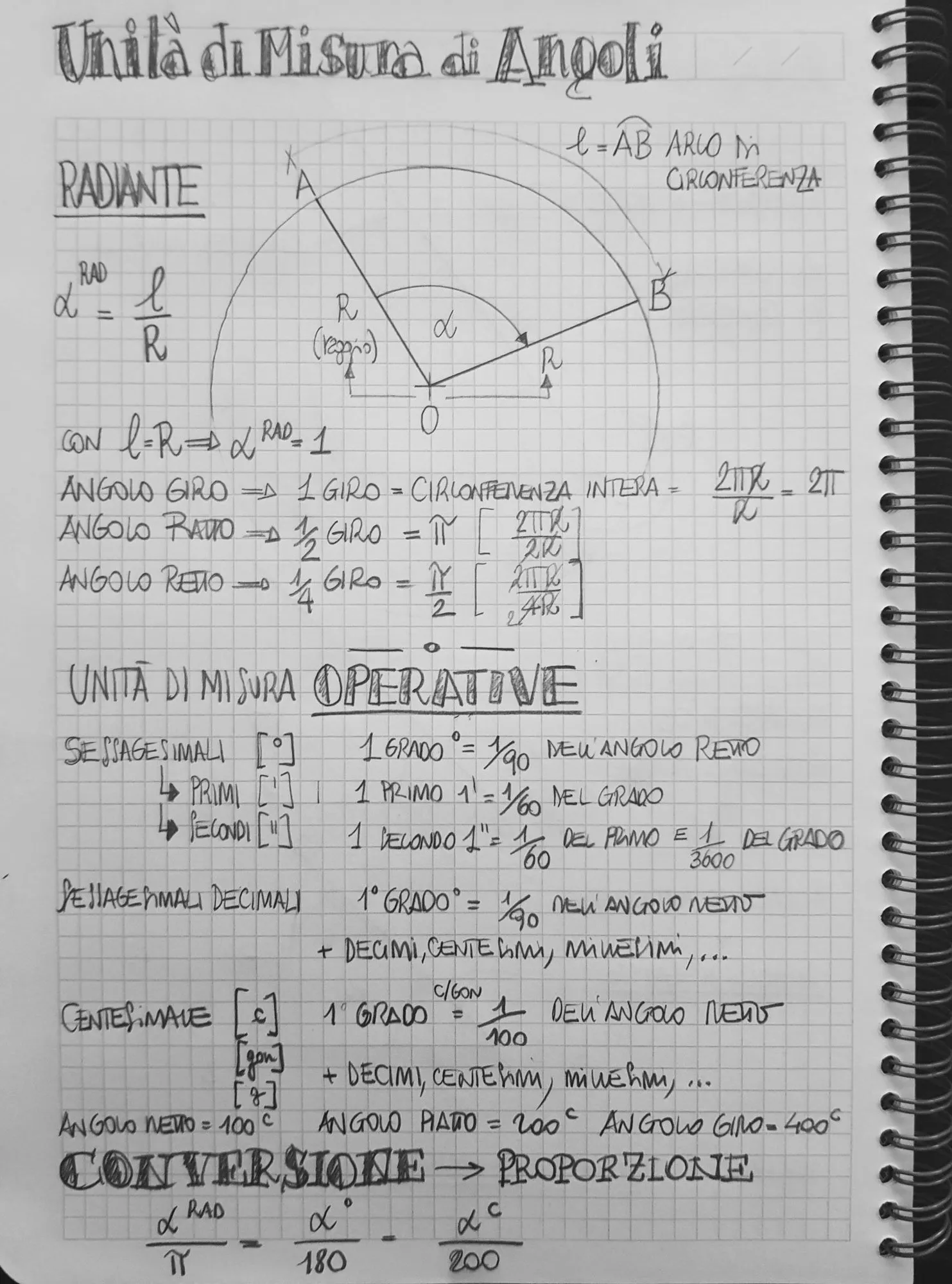
I use this property and write (actually someone else did it before me) that one radian is the central angle, in a circle of radius R, that subtends an arc “l” as long (along its length) as the radius “R”.
As usual, definitions are very rigorous but often not very warm.
Let’s see it more practically.
If you want to know how much the angle AÔB measures in radians, you have to build a circle on it with its centre at the vertex of the angle and a radius equal to side OA, which is also equal to OB.
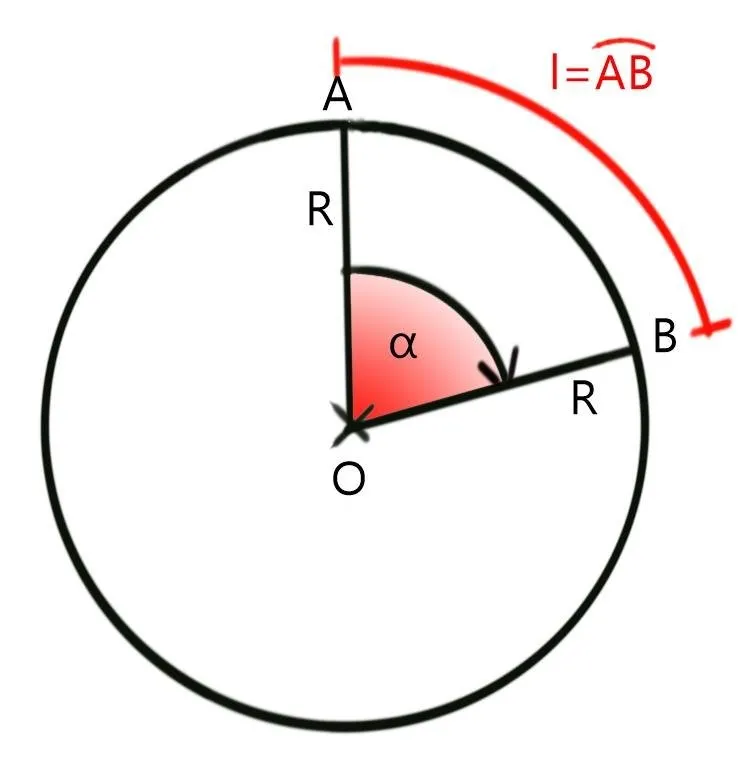
The angle alpha, in radians, equals the ratio between the arc AB, which measures “l”, and the radius of the circle R.
AÔBrad = l/R
To show that it is an angle measured in radians, and not confuse it with the other units, you put a superscript “rad” on its name or symbol.
From here, with little effort and remembering that the formula for the circumference is 2πR, you can quickly say that:
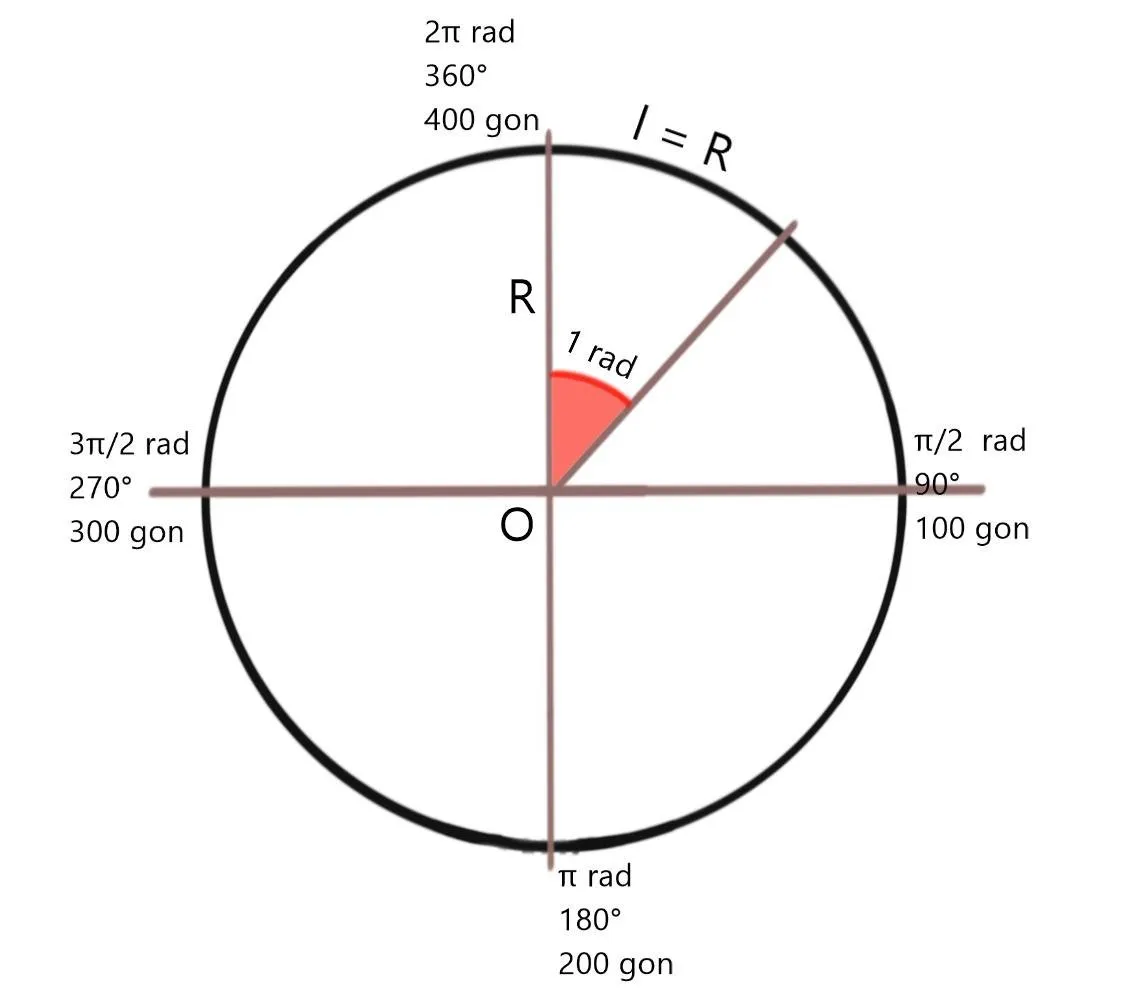
- if l = R then AÔBrad = 1;
- full angle = 2πR/R = 2π;
- straight angle = πR/R = π;
- right angle = πR/2R = π/2.
Given how it is defined, you can see why it has no dimension.
The arc l, in the numerator, is a length [L], and so is the radius R, in the denominator.
[L] / [L] cancel out, and there’s the dimensionlessness…
The radian is said to be the absolute unit of angle measurement.
It is the one officially included in the International System and is used in all theoretical, mathematical-geometric treatments (and not only).
But it is a bit sterile and not very practical to use in the field when measuring.
So surveyors leave it to mathematicians and prefer something else…
Operational measurement systems
Try working rigorously with π (3.14159265358…) always under your feet and you’ll see that having an irrational number in every measurement doesn’t sit well with the idea of data precision and survey accuracy.
Surveyors prefer something else: sexagesimal degrees and gons.
The sexagesimal degree
Take a full angle and divide it into three hundred and sixty (360) parts.
Each one is a sexagesimal degree [°].
Now take a degree and divide it into sixty (60) parts to find the minute [′].
Finally divide the minute again by sixty to get the second [″].
Degrees, minutes and seconds measure an angle in the sexagesimal system.
48° 17′ 26″ reads: 48 degrees, 17 minutes and 26 seconds.
For higher precision, the seconds can have decimals (52° 34′ 20.92″), while degrees and minutes are always whole numbers.
This way of measuring angles is the oldest.
The Babylonians already used it.
So much for radians!
🙂
The choice to divide the full angle into 360 parts comes from their astronomy.
Since the solar year is roughly 360 days, a sexagesimal degree corresponds roughly to the angle the Earth covers on its orbit in one day.
The sexagesimal degree also works well in geometry because, for example, the interior angles of regular polygons (at least up to the hexagon) are easy to remember:
- equilateral triangle: 60°;
- square: 90°;
- pentagon: 108°;
- hexagon: 120°
However, operations between sexagesimal angles don’t follow the “classic”, decimal way: you have to work separately on degrees, minutes and seconds and then carry any excess.
It isn’t difficult, but it isn’t quick either.
It suited mental arithmetic, but it is less immediate for calculators, PCs and software.
The decimal degree
To make operations between sexagesimal angles simpler, the sexagesimal decimal system, or simply decimal degrees, is widely used.
A decimal degree is one three-hundred-and-sixtieth of the full angle, just like the sexagesimal degree, but the subdivisions of the degree are expressed in decimal form.
How do you do it?
It is simple.
- Take an angle in the sexagesimal system: 48° 17′ 26″;
- Take the number of degrees: 48°;
- Divide the minutes by 60: 17/60 = 0.2833;
- Add the result to the degrees: 48 + 0.2833 = 48.2833;
- Take the seconds and divide them by 3600 (yes, because there are 60×60=3600 seconds in a degree): 26/3600 = 0.0072;
- Add them to the result of step 4: 48.2833 + 0.0072 = 48.2905
- The sexagesimal angle in decimal degrees is 48.2905
This system is handy for calculations with calculators and in some software that works with angles.
Arithmetic follows the rules of decimal numbers.
48.256343 + 21.859672 = 70.116015
And if I have a measurement in decimal degrees and want to go back to sexagesimal?
For example: 32.4550°.
It is a matter of doing the steps in reverse:
- the degrees are still 32;
- to find the minutes: 0.4550 x 60′ = 27.30′;
- so the minutes are 27;
- for the seconds I do the same with the decimals of the minutes, from step 2: 0.30 x 60″ = 18″;
- So the sexagesimal angle measures 32° 27′ 18″.
The centesimal degree (gon)
The unit most used in Italian surveying is the centesimal degree, or gon.
At least it was, until the total station was used almost exclusively.
It was first used by Ignazio Porro in 1850, when he built the first centesimal theodolites.
Now GPS (which I should call GNSS), by now well established in surveying, is bringing sexagesimal and decimal degrees into common, everyday use.
The gon is one hundredth of a right angle.
Its symbol can be written as [c], [gon] or [g].
A right angle measures 100 gon.
A straight angle is 200 gon.
A full angle is 400 gon.
After the whole number, which gives the degree, you use tenths, hundredths, thousandths, …, decimals, as in decimal degrees.
Since I want to be complete to the end, I’ll tell you that in some remote corner of a surveying cellar you might find centesimal minutes [–] and centesimal seconds [=].
I’ve never come across them…
Converting between units
Now that I’ve told you which units are used for angles, I must give you the instructions to move from one system to another.
It is based on a proportion and on the principle that, whatever system you choose, the magnitude of an angle stays the same.
A straight angle will always be half a turn.
If you double the size of an angle, its measurement doubles too, whatever unit system you are using.
So you can write this relation, where ß (beta) is any angle:
ßrad / π = ßgon / 200gon = ß° / 180°
Moving from one system to another is quite simple.
You only have to watch one thing.
To do the operations in the proportion (multiplication and division), you first need to convert sexagesimal degrees into decimal degrees, so that you have quantities everywhere that can be handled mathematically with the rules of decimal numbers.
An example
I’ll convert the angle µ = 48° 17′ 26″ into gons and then into radians.
First I go from sexagesimal degrees to decimal degrees.
µ = 48° + (17/60)′ + (26/3600)″ = 48.2905°
Now I apply this proportion to get gons:
µgon / 200gon = µ° / 180°
Since µ° = 48.2905°
and the product of the means equals the product of the extremes,
I find that: µgon = 48.2905° x (200/180) = 53.6561 gon
Finally I look for the radians.
I use decimal degrees with this proportion:
µrad / π = µ° / 180°
(I could just as well have used gons.)
From this it follows that:
µrad = µ° x (π/180) = 0.8428 rad
A spreadsheet for conversions
As you’ve seen, moving between units isn’t complicated, but it can take some time.
Especially if you have lots of angles to convert.
I set up a spreadsheet that does all this (semi)automatically.
It is available to download for 3DMetrica supporters on the 10 € tier, in the Patreon post.