Oriented angles
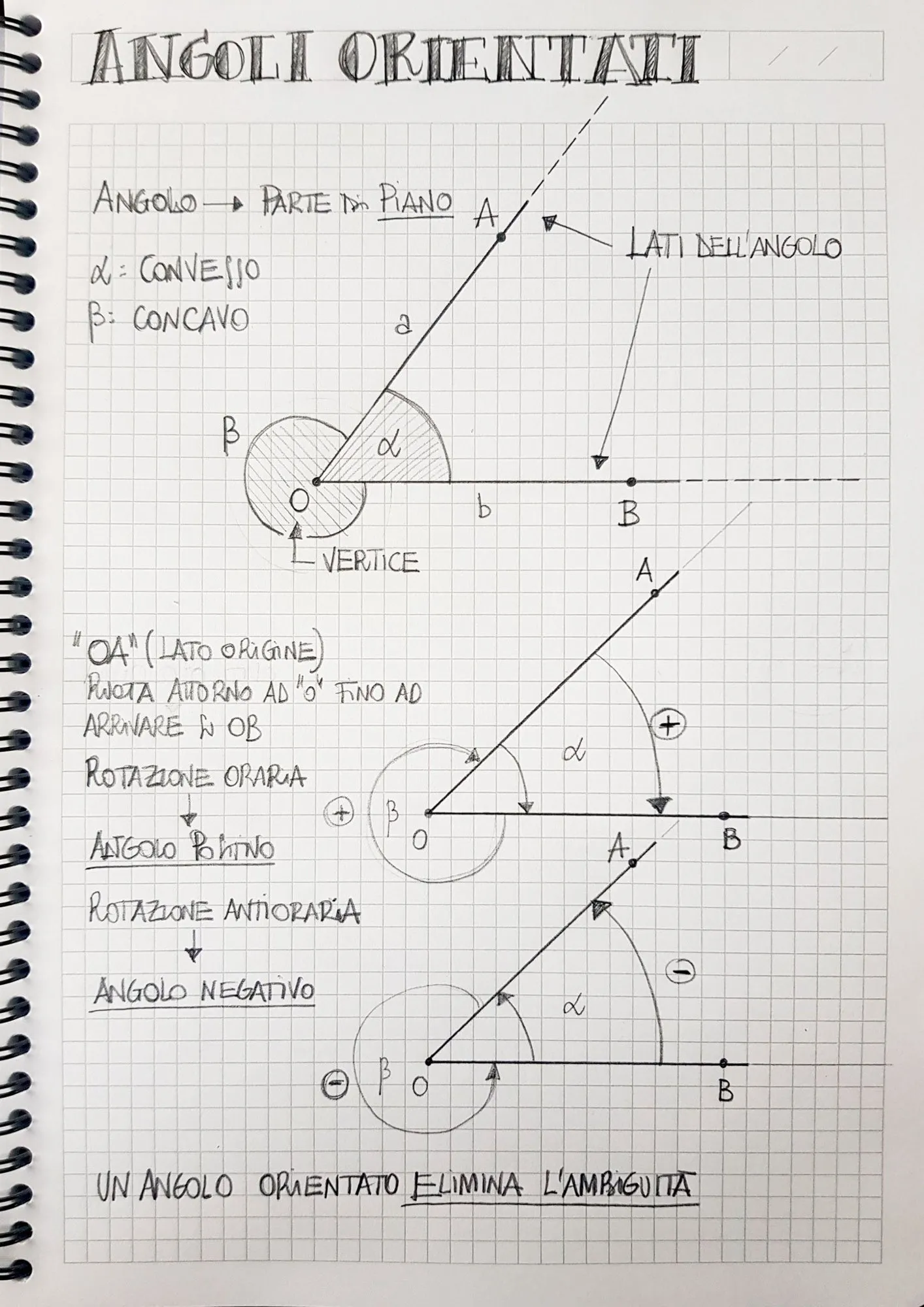
The geometric definition of an angle is ambiguous, and surveyors hate ambiguity. Giving an angle a direction makes it uniquely determined.

If there is one important quantity in surveying, it is the angle!
You could say, without jumping to conclusions that are too wrong, that it all started with measuring angles, many centuries ago.
Angles helped people in agriculture, in measuring the size of the Earth, in navigation and in drawing maps.
Put like that it sounds like the opening of a 1990s documentary, but that is more or less how it went.
If I could give my own personal definition of an angle (not very rigorous and not at all technical), I’d write this: the angle is the founder of Surveying, the ancestor where everything began.
But, of course, it means nothing in practice!
🙂
An ambiguous definition
A surveyor reading the geometric definition of an angle finds in it, from their point of view, something they never want to deal with: ambiguity.
Classical geometry says: “An angle is each of the parts into which a plane is divided by two rays starting from the same point”.
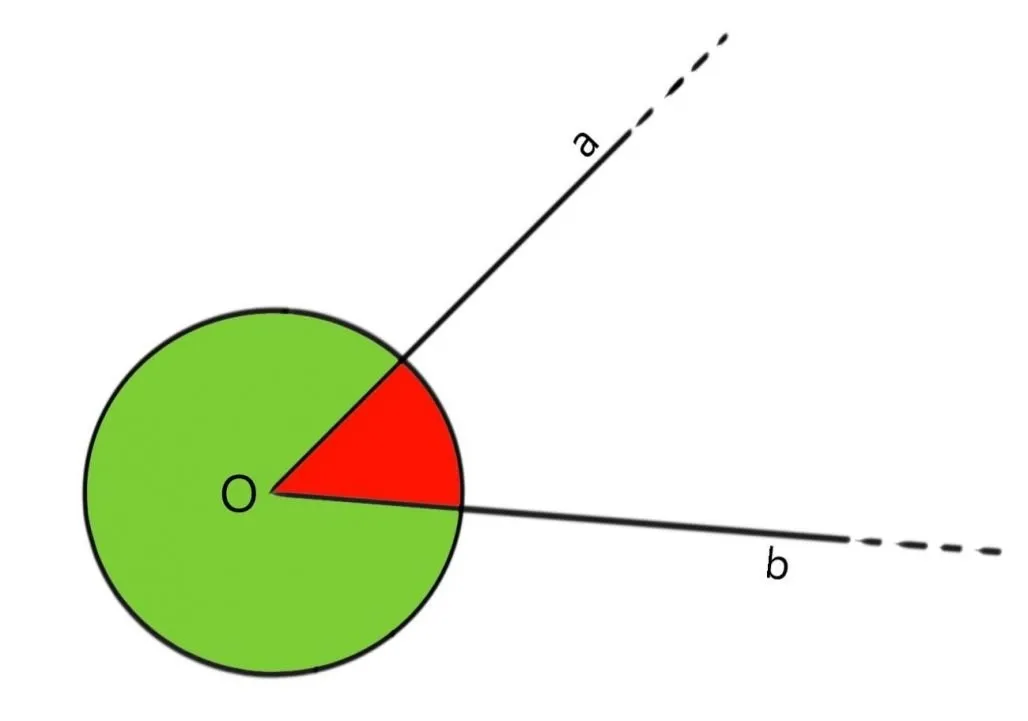
Take a point “O”.
Draw a ray “a” from it.
Then, again starting from “O”, draw a second ray “b”.
To understand the angle it is better if a doesn’t coincide with b (although there would be nothing bad or wrong about it).
The two rays define a plane, because one and only one plane passes through two (half-)lines.
And this plane is divided into two parts by the rays.
In the image below there is the red one and the green one.
You could also do it this way:
Take three distinct points and call them A, B and O.
These three points again define a plane.
Just as only one plane passes through two lines, only one plane passes through three points.
Join point O to A and do the same, joining O to B.
Now you have two segments, OA and OB, and the plane is still divided into two parts, two angles.
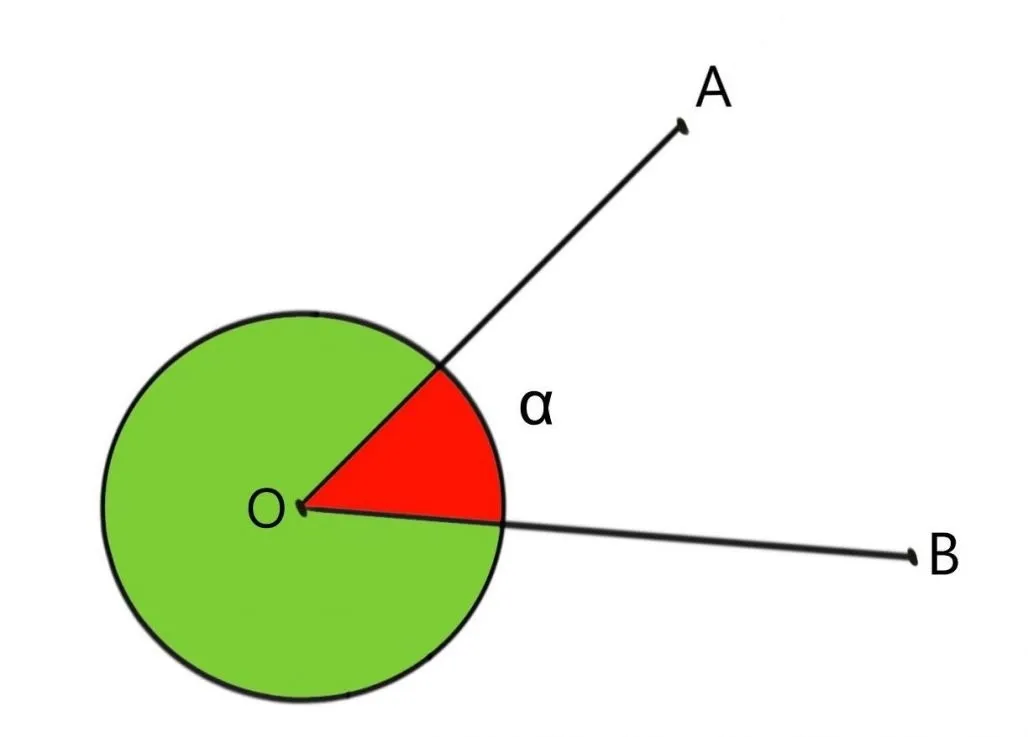
Whichever way you go, an angle is a piece of plane!
Sides, vertex and name of the angle
The common origin of the rays (or the common end of the segments), point O, is the vertex of the angle.
The two rays a and b (or the segments OA and OB) are the sides of the angle.
To “name” an angle you can use the letters of the points you’ve just drawn, but you must put the vertex letter in the middle.
And then put a circumflex accent over it (the vertex letter).
Like this: AÔB…
Or you can use Greek letters: alpha, beta, gamma, …
Oh, one last thing.
The green angle is reflex (because it contains the extensions of its sides).
The red angle is convex.
There’s the ambiguity!
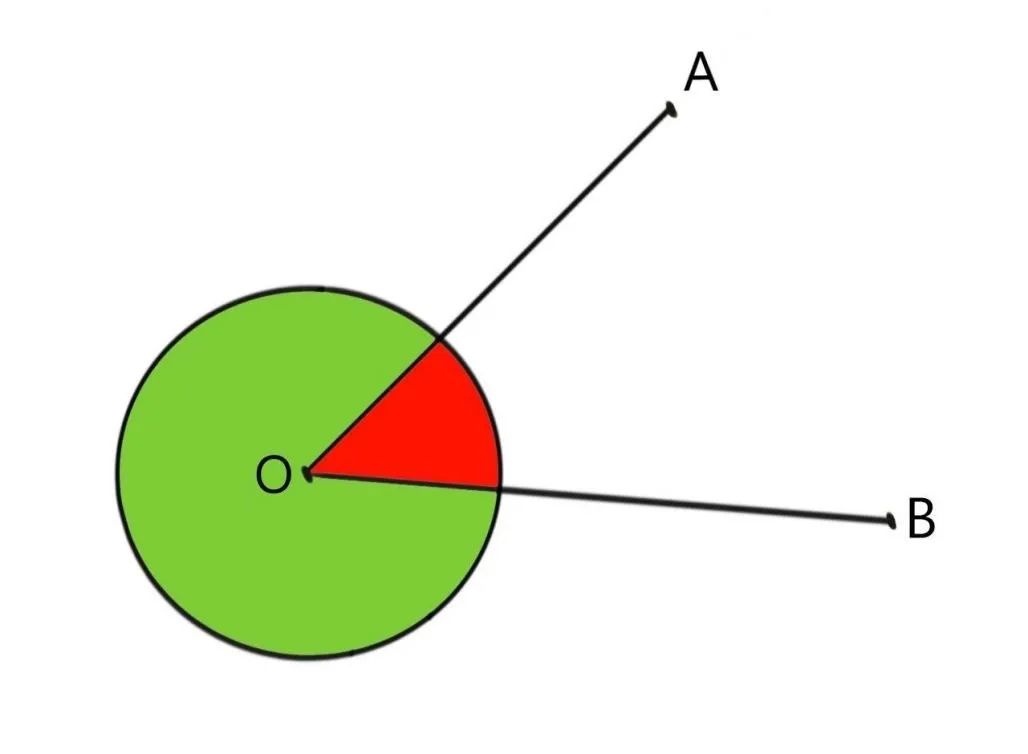
Look at the red angle in the figure above.
Can you say, only and exclusively by writing AÔB, without the help of gestures, sign language or smoke signals, that whoever reads you and sees the coloured drawing will understand you mean the red angle?
With no margin of error?
No, you can’t.
By the geometric definition of an angle, AÔB could also mean the green one…
And it wouldn’t be wrong.
AÔB is an ambiguous definition of an angle.
Ambiguity is a sneaky thing in surveying (and not only there) because it doesn’t let me be sure of what I want to communicate.
Ambiguity brings with it at least two different interpretations of what you’re looking at, and you can’t say that either is wrong.
I assure you it is a big problem for a surveyor who takes measurements in the field with their instruments and then represents them for others to use for their own purposes.
The dictionary definition of “ambiguous” is “open to more than one interpretation”.
Its opposite is “certain, clear, obvious, …”
Exactly what a surveyor is looking for!
But the word I prefer (and not only me) is uniquely determined.
It is a bit pompous, but strong and effective!
But how do I get rid of this ambiguity and make sure whoever is listening understands which angle I mean?
I use orientation.
Oriented angles
Orienting an angle means giving it a direction, a sign, a sense of rotation.
I have to decide who does the rotating and see how.
I make one of the two sides move, rotating around the vertex O.
I choose OA.
The side that moves is called the initial side.
But when does it stop?
It stops when it hits the other side, OB, the terminal side.
The part of the plane that OA sweeps in its rotation up to OB tells me how big the angle is, its magnitude.
But I’m still ambiguous!
Because I haven’t yet said which way OA moves.
If the initial side moves clockwise, the sign is “+”, the angle is positive.
If instead it goes against the hands of the clock, rotating anticlockwise, the angle is negative, the sign is “–”.
(This is the surveying convention: in mathematics positive angles usually go anticlockwise.)
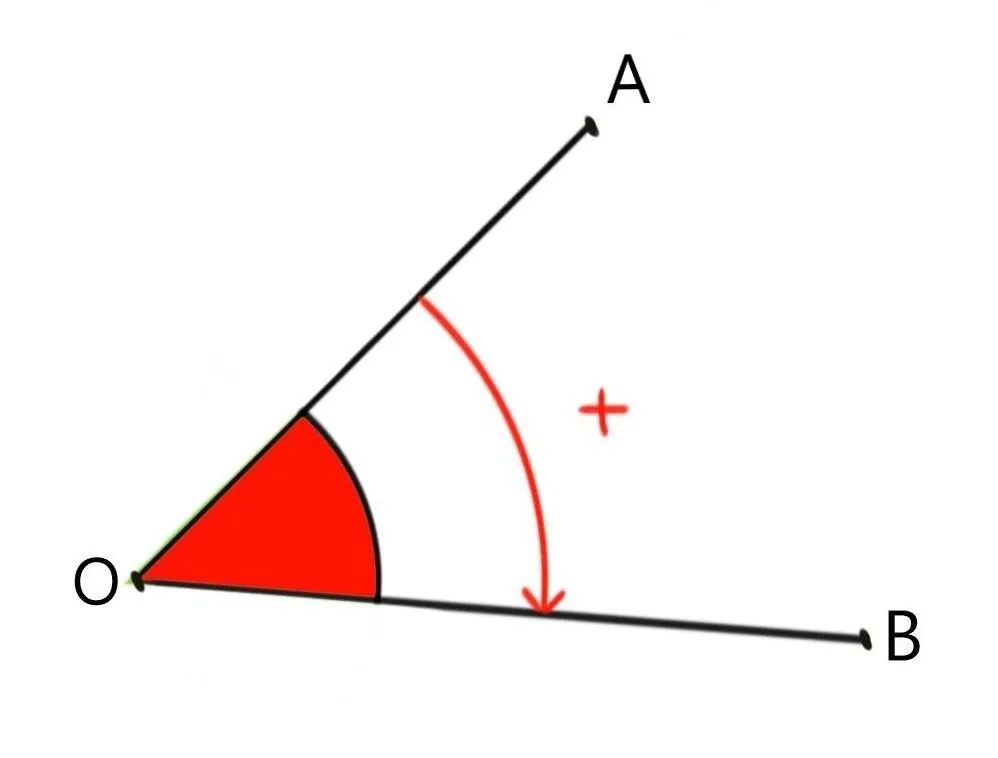
Now that I’ve defined the direction, I’ve removed the ambiguity in identifying the angle.
To name it I use the order of the point letters.
I write the initial side first.
So writing AÔB means that OA moves and reaches OB.
Conversely, if I write BÔA, it is side OB that rotates.
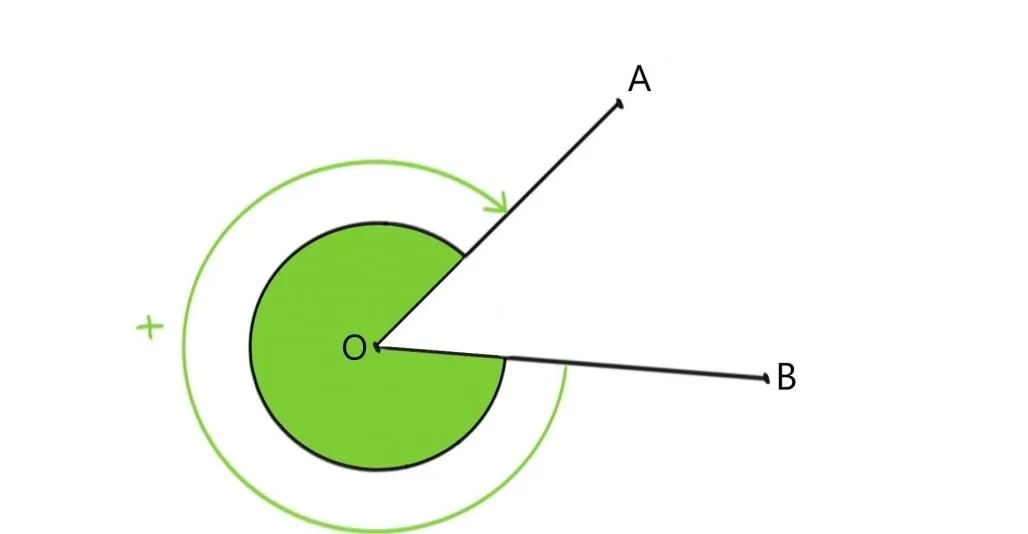
Goodbye ambiguity
Now there are no more doubts.
If I write AÔB = 100° I mean exactly the part of the plane generated by side OA which, rotating clockwise around O, ends on OB after sweeping a magnitude of 100°.
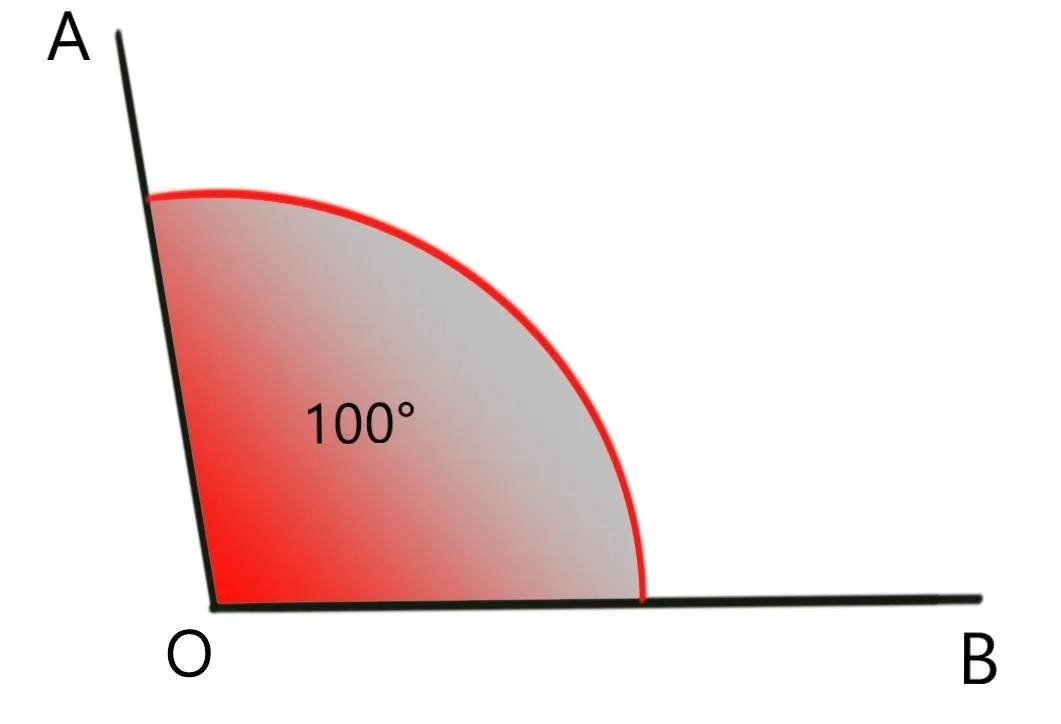
If instead I say BÔA = – 180°, it means OB rotates anticlockwise around O and ends on OA after 180°.
It is uniquely determined!
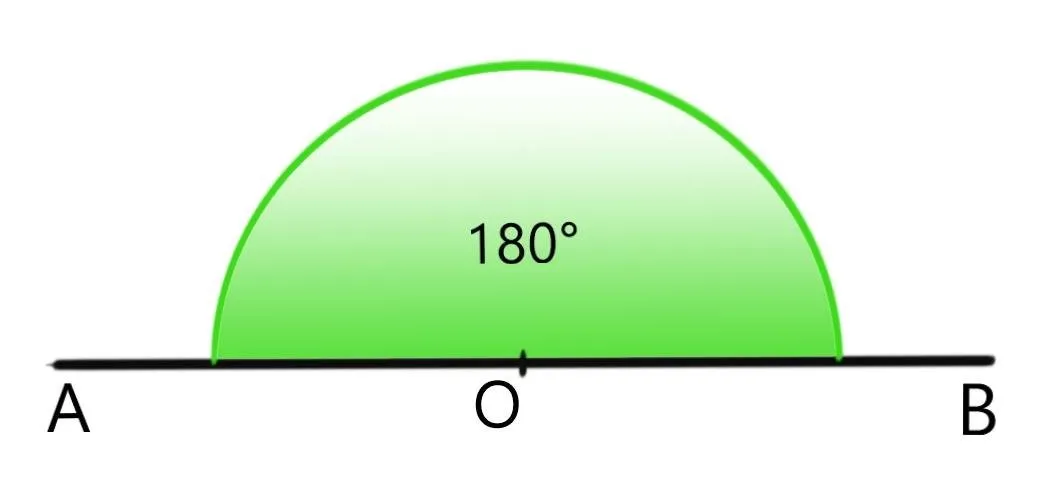
An oriented angle can also measure more than 360°.
The initial side can rotate, like a crazy counter, several times around the origin and stop when it has reached its magnitude.
Advantages of oriented angles
An oriented angle removes the ambiguity of the geometric definition of an angle, and gives meaning to both positive and negative values as well as to magnitudes larger than a full angle.
It doesn’t take much to turn an angle into an oriented angle, but the benefits are clear!