
GNSS: the phase centre of your antenna
If you post-process raw GNSS data, you need to know where the phase centre of your antenna is, or you risk errors of several centimetres in height.
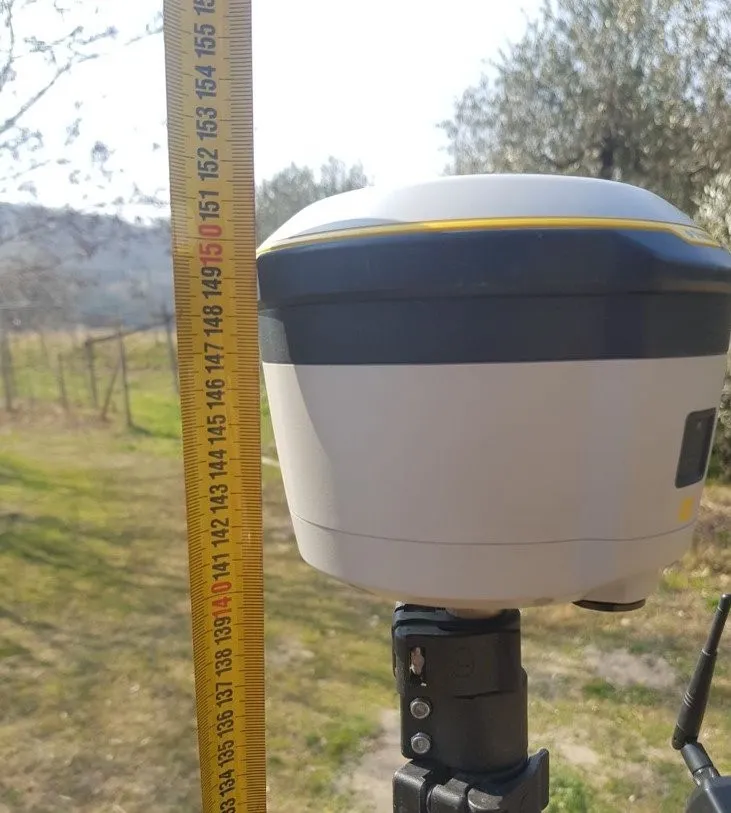
You should know where the phase centre of your GNSS antenna is…
Especially if you post-process raw data, whether for static positioning or for the kinematic positioning of something that moved and whose trajectory you want to recalculate (a drone for a LiDAR survey or a boat for a bathymetric survey).
If you don’t know where it is, you could make gross errors in the height of what you are calculating, even of several centimetres.
The phase centre is a point inside a receiver where its position is calculated by processing the data and information it receives from the satellites.
If you use it in RTK mode, knowing this may not be strictly necessary.
Much of the field control and data collection software that connects to your GNSS knows how it is built and automatically adjusts the measurement of the ground point according to the pole height.
So, even if you don’t notice it, the position of the phase centre is already taken into account in the measurement.
But if you process raw data, you have to tell the processing software where the point at which they are recorded is. It is not at the top of the pole, but a little higher, inside the receiver, at the phase centre.
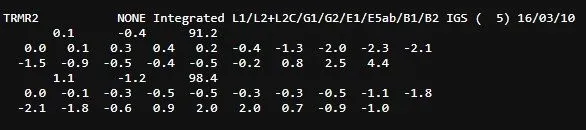
Here is a very interesting site with a wealth of practical geodetic information, which Luca Gusella pointed me to when I asked him about the phase centre of my GPS.
You will find practically everything on the market, plus whatever has passed through the hands of operators all over the world.
Your receiver is probably there too.
P.S.
Go to the “Antenna Calibration” section, open the “Browse Antenna Information by Company Brand and Model” menu, and look for the brand and then the model of your receiver.
Next to your antenna click “AntInfo” and find, among the numbers, the phase centre for the L1 and L2 frequencies (in mm).
The information may vary depending on the antenna you are looking at and how it is built.