Focal length in photogrammetry
Real and 35mm-equivalent focal length, crop factor, and why you must use the real focal length to calculate the GSD of a photogrammetric survey.
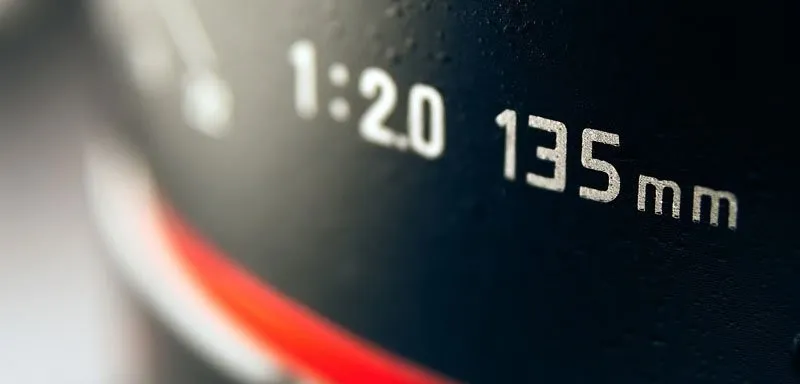
In photogrammetry, focal length determines the Ground Sampling Distance (GSD).
It’s an important factor!
In this article I’ll talk about real and equivalent focal length and which of the two you should use to calculate the GSD.
You can also download, for free, a spreadsheet to go from one to the other based on your camera’s lens.
Ground sampling distance (GSD)
Before talking about focal length, I need to tell you something about the Ground Sampling Distance (GSD), an important parameter in photogrammetry.
I’d written a general article about it, which you can read here, and a more specific one on photogrammetry over sloping ground, which you’ll find here.
If you like, read them to go a bit deeper into the subject (which really matters in photogrammetric surveys!).
Here I’ll just write a few quick things about the GSD.
The GSD affects the accuracy of an aerial photogrammetric survey.
The GSD is the distance between the centres of two neighbouring pixels of a digital image, measured on the real ground.
The GSD tells you how big a pixel is, measured on the ground.
The GSD is measured in mm/pixel or cm/pixel.
The smaller the GSD, the more detail an image shows.
The formula to calculate it is:
GSD = (D x d) / f
D is the distance between camera and ground (in nadir aerial photogrammetry, the flight height);
d is the side length of a pixel (which is square) of the camera sensor (it depends on the sensor size and resolution);
f is the focal length of the lens.
Changing these three values changes the GSD, in direct proportion to D and d and in inverse proportion to f.
If I move the drone further from the ground, D increases and so does the GSD.
If I increase the focal length, f grows and the GSD shrinks.
Now I can tell you something about focal length.
Focal length
Focal length is a physical property of a lens.
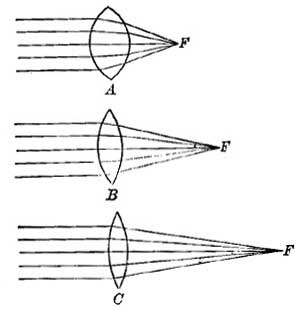
A beam of parallel rays passing through a (convex, like those in camera lenses) lens is all deflected to the same point, the lens’s focal point.
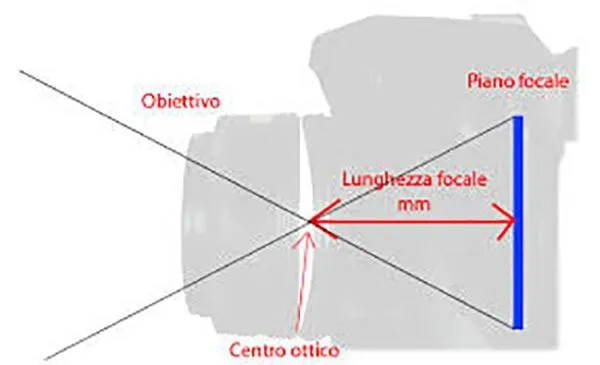
Focal length is the distance between the centre of the lens (the nodal point) and its focal point, measured in mm.
A more curved lens has a shorter focal length than a flatter one.
Increasing the focal length takes you from ultra wide-angle lenses to telephotos:
- 16mm is an ultra wide-angle;
- 24mm and 35mm are wide-angles;
- 50mm is a normal lens;
- 70mm, 150mm, 300mm are telephotos.
Focal length affects a lens’s minimum focusing distance, its depth of field, its magnification and its angle of view.
Focal length and focusing
You can’t take a camera, stick the end of the lens onto what you’re photographing and hope it’s in focus.
It doesn’t work like that.
You have to step back a bit.
With long focal lengths you have to step back further than with short ones.
Focal length and depth of field
Depth of field indicates how much of an image can be considered in focus.
It depends on the aperture, the distance of the subject and the focal length.
With aperture and distance constant, the longer the focal length, the shallower the depth of field.
Focal length and magnification
The distance of an object from a lens determines its magnification.
The closer the object gets to the lens, the bigger its image becomes.
Magnification depends not only on the distance S of the object from the centre of the lens but also on the focal length f. The longer the focal length, the greater the magnification, according to this formula:
M = f / (f – S)
Focal length and angle of view
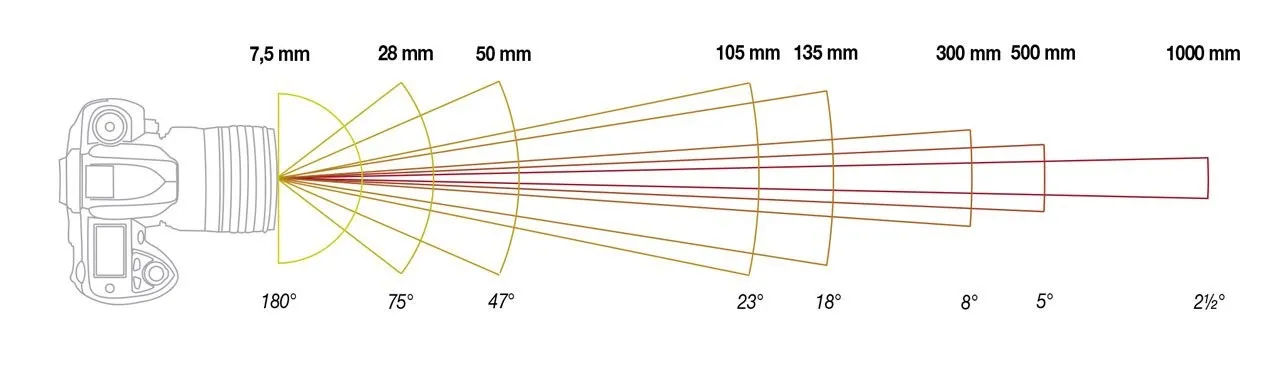
Focal length affects how much of a framed scene is recorded in an image.
The angle of view, or Field of View (FOV), measured in degrees, depends on the focal length.
A short focal length lens makes objects smaller but captures a wider part of the scene, while a long focal length lens enlarges them but captures a narrower part.
A wide-angle has a larger FOV than a telephoto.
Prime and zoom lenses
Then there are lenses with a fixed focal length (primes) and lenses with a variable focal length (zooms).
On a zoom you turn a ring to change the focal length in real time.
Real focal length and equivalent focal length
In the days of film cameras, with few exceptions, 35 mm film was made of frames measuring 36×24 mm.
These had become something of a standard in photography (excluding medium and large format cameras).
So it was fairly easy to compare lenses by focal length.
Digital photography changed things quite a bit.
Cameras have sensors of different sizes, and lenses have very different focal lengths depending on the cameras they’re mounted on.
To bring order and help photographers understand the type of lens and its main characteristics, the “equivalent focal length” was invented.
It relates the real focal length of a lens to that of an equivalent lens for 35 mm or full-frame cameras (a digital camera with a 36×24 mm sensor, the same size as the film frame).
Digital technology was so strong a push that when you buy a compact camera or a lens it’s almost easier to find the equivalent focal length than the real one.
With drones it’s certainly the case!
If you read the specifications of the cameras on many consumer drones (DJI, Yuneec, Parrot), you’ll find almost only equivalent focal lengths.
Focal length in photogrammetry
To calculate the Ground Sampling Distance and plan a photogrammetric survey you must use the real focal length.
Don’t use the equivalent value.
The GSD formula comes from a geometric similarity between triangles.
Here’s the reference image.
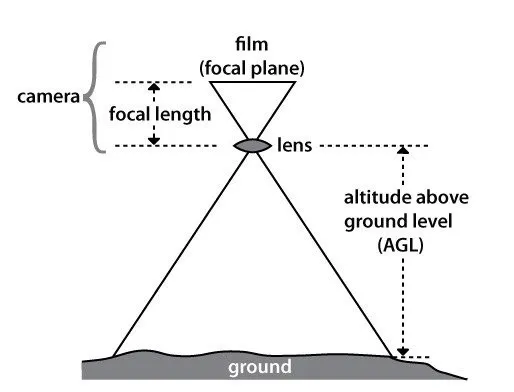
The height of the upper triangle is the real focal length.
If you replace it with the equivalent one, you get the wrong GSD.
The focal length f is in the denominator of the GSD formula.
They’re inversely proportional.
If one goes down, the other goes up, and vice versa.
Unless you use a full-frame or medium format camera, the equivalent focal length is always larger than the real one.
If you use the equivalent focal length, you put a larger value than the real one into the GSD formula.
So the GSD you calculate will be smaller than the real one.
And you’ll base your photogrammetric project on wrong information.
Which will lead you to incorrect results.
In fact, fooled by a low GSD, you might fly higher, convinced you’re taking photos with enough detail for your job.
But you won’t be, because the real GSD is larger than the one you calculated with the equivalent focal length.
It depends on the real focal length (which is smaller).
And you might not deliver a photogrammetric survey with the required detail and accuracy.
From equivalent to real focal length
Calculating the real focal length from the equivalent one is simple.
It’s a division.
But to do it you need to know the size of the camera sensor (in mm) to compare it with a full-frame or 35 mm sensor.
Or it may be enough to know a factor called the “crop factor”.
The crop factor is a (dimensionless) number that tells you how much larger the diagonal of a full-frame sensor is than that of your camera’s sensor.
The crop factor changes from sensor to sensor.
If you know it, you can immediately calculate the real focal length from the equivalent one.
If you don’t, you have to calculate it from the sensor’s dimensions (width B and height A).
The diagonal of a B x A sensor is: Csensor = square root (A² + B²).
The crop factor of that sensor is CF = C35mm / Csensor,
where C35mm is the diagonal of the full-frame sensor.
The crop factor of a full-frame sensor is 1.
The crop factor of a medium or large format sensor is less than 1.
The crop factor of all other cameras is greater than 1.
The larger the crop factor, the smaller the sensor.
Once you know your sensor’s crop factor, you can calculate the real focal length by dividing the equivalent focal length by the crop factor.
fr = fe / CF
This (fr) is the value to put into the Ground Sampling Distance formula.
Two examples based on the instruments I use in aerial photogrammetry.
The DJI Phantom 4 Pro has a 1″ sensor, with a crop factor of 2.7.
The lens of the built-in camera has an equivalent focal length of 24 mm.
The real focal length to use in the GSD calculation is f = 24 / 2.7 = 8.8 mm.
The DJI Spark has a 1/2.3″ sensor, a crop factor of 5.64, a 25 mm (equivalent) lens and a real focal length of f = 25 / 5.64 = 4.4 mm.
A spreadsheet for focal length
Although going from equivalent to real focal length and back is really simple, I prepared a spreadsheet that might make the sums easier.
You can download it for free here (the labels are in Italian), without leaving an email, name or contact.
The sheet is really simple!
In the first part there are two boxes to calculate the real focal length from the equivalent one, and vice versa.
In the second part there’s a table with the physical dimensions of the most common digital sensors.
You’ll find width, height, diagonal, area and crop factor.
Take your sensor’s crop factor and enter it in the two boxes above to convert between focal lengths.
In the last part there’s a row where you can calculate the crop factor if your sensor isn’t in the list.
To do it, though, you’ll need to know its dimensions (width and height).
It’s really intuitive and simple!
I understand it isn’t a revolutionary or innovative tool, but I use it often and find it handy and fairly quick.
I hope it’s useful in your work too.
And I hope I’ve also given you some interesting information on focal length in photogrammetry.
Let me know what you think!
Thanks for giving me some of your time to read this article!
If you’d like to add to the spreadsheet, you’re very welcome.
You can contact me on Telegram at @paolocorradeghini, or by email from the contact page.
See you soon!
Paolo Corradeghini